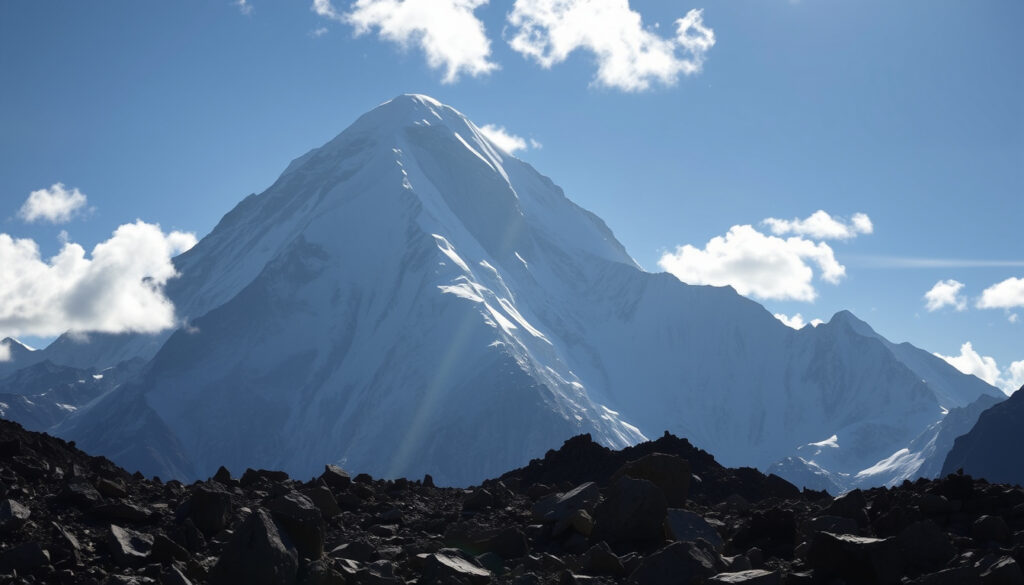
Mount Everest: Height, Location, Deaths, Cost & 2 PM Rule
The highest point on Earth symbolizes both ambition and vulnerability, yet the financial cost and human toll are rarely laid out side by side. This guide cuts through the lore to give you the facts on where Everest sits, how much it really costs, why the 2 PM rule exists, and what happens to those who don’t make it back.
Elevation: 8,848.86 m (29,031.7 ft) ·
Location: Border of Nepal and Tibet (China) ·
First Ascent: May 29, 1953 by Edmund Hillary and Tenzing Norgay ·
Total Deaths (as of 2025): Over 330 ·
Typical Climbing Duration: About 2 months ·
Average Permit Cost: $11,000 per person (Nepal side)
Quick snapshot
- Height measured as 8,848.86 m in 2020 (Encyclopaedia Britannica)
- Location on Nepal–Tibet border (Encyclopaedia Britannica)
- First ascent by Hillary and Norgay in 1953 (Encyclopaedia Britannica)
- Over 330 recorded deaths as of 2025 (Climbing Kilimanjaro)
- Exact number of deaths varies by source and unreported incidents
- Cost of climbing can vary widely based on services
- Age and identity of some bodies remain disputed
- Effectiveness of the 2 PM rule in reducing deaths remains unconfirmed
- 1924: George Mallory and Andrew Irvine disappear near summit
- 1953: First confirmed ascent by Hillary and Norgay
- 1996: Disaster kills 8 climbers in a single day
- 2020: New official height of 8,848.86 m announced
- Nepal may enforce stricter regulations, including the 2 PM rule as a formal policy
- Permit fees continue to rise, potentially exceeding $15,000 in 2026
- Climate change is altering ice conditions on the Khumbu Icefall
- Record summit numbers expected as infrastructure improves
Six key facts, one pattern: the mountain is simultaneously well-documented and full of unknowns.
| Label | Value |
|---|---|
| Elevation | 8,848.86 m (29,031.7 ft) |
| Location | Nepal–Tibet (China) border |
| First Ascent | May 29, 1953 (Edmund Hillary & Tenzing Norgay) |
| Total Deaths | Over 330 (as of 2025) |
| Average Climbing Duration | ~2 months |
| Typical Cost | $35,000–$100,000 |
Which Country Is Mount Everest In?
Mount Everest sits on the border between Nepal and the Tibet Autonomous Region of China. The precise boundary has been a matter of diplomatic agreement, but both countries share the mountain. The south side is in Nepal, the north side in Tibet.
What Is the Exact Height of Mount Everest?
- The officially recognized height, measured in a 2020 joint survey, is 8,848.86 m (29,031.7 ft) (Encyclopaedia Britannica).
- Previous measurements varied slightly; the 2020 Nepal–China survey resolved the discrepancy.
What Continent Is Mount Everest In?
- Everest is part of the Himalaya range in Asia.
- It lies on the border of two Asian nations: Nepal and China.
The height debate is settled for now, but tectonic activity means Everest grows about 4 mm per year. For mapmakers and climbers, the official figure is the one to trust.
The implication: even “fixed” measurements shift as the planet moves under our feet.
How Many People Have Died on Mount Everest?
Since records began in 1922, over 330 climbers have died on Everest, according to the Himalayan Database cited by Climbing Kilimanjaro. A Wikipedia summary puts the figure at 340 as of May 2024, but the exact number is difficult to verify due to unreported deaths and missing bodies.
Who Was the Famous Body Found on Everest?
The most famous body is known as “Green Boots,” widely believed to be Tsewang Paljor, an Indian climber who died in the 1996 disaster. The body lies in a limestone cave near the summit and has become a grim landmark for climbers passing above 8,500 m.
What Is the Oldest Body Still on Mount Everest?
The oldest known body is that of George Mallory, who disappeared in 1924 during his third Everest expedition. His remains were found in 1999 by a search expedition, 75 years after his death. Unlike “Green Boots,” Mallory’s body was found at a lower elevation, and the question of whether he reached the summit before dying remains unanswered.
Around 200 bodies remain on the mountain, many serving as unofficial markers. For the families of the missing, the mountain is both a grave and a monument.
Why Does It Cost $40,000 to Climb Mount Everest?
The widely quoted $40,000 figure is a rough average, but actual costs range from $35,000 to over $100,000. The main driver is the permit fee, which on the Nepal side is about $11,000 per person — and according to Green Valley Nepal Treks, that fee is expected to rise to $15,000 in 2026. Additional costs include guides, bottled oxygen, high-altitude gear, insurance, and logistics.
What Do Permit Fees and Logistics Cost?
- Nepal spring-season permit: $11,000 (current) (Green Valley Nepal Treks)
- Winter/monsoon permit: $3,750 (Explore Himalaya)
- Liaison officer, garbage deposit, and base camp fees add several thousand more.
How Much Does a Guided Expedition Cost?
- Basic guided climbs start around $41,000 (ExpedReview)
- Median expedition price: $54,995
- Ultra-luxury packages can exceed $300,000.
For a climber from the U.S. or Europe, the cost is a second mortgage. For a Nepali Sherpa, the same expedition may pay a year’s salary — but the risk is shared.
How Long Does It Take to Climb Mount Everest?
Most expeditions last about two months, from arrival in Kathmandu to the summit and return. The timeline includes rest days, acclimatization rotations, and weather windows.
What Is the Typical Climbing Timeline?
- Days 1–10: Trek to Everest Base Camp (5,364 m).
- Days 10–30: Acclimatization rotations up to Camp 2 (6,400 m) and Camp 3 (7,200 m).
- Days 30–50: Rest and wait for summit window.
- Days 50–60: Summit push and descent.
How Long Does the Summit Push Take?
- From Camp 4 (South Col, 7,950 m) to the summit: 10–12 hours.
- Descent back to Camp 4: 4–6 hours.
- Total summit day: 14–18 hours of continuous effort.
Every extra day at high altitude increases the risk of frostbite, exhaustion, and avalanche. Expeditions that rush through acclimatization often fail — or worse.
Why Do Planes Not Fly Over Everest?
Commercial airlines avoid flying directly over Everest because the high altitude — above 8,800 m — is beyond the safe operating ceiling of most jet aircraft. Jet engines generate less thrust in thin air, and turbulence can be severe. In the event of an emergency, there is no terrain for an emergency landing.
What Are the Aviation Risks Near Everest?
- Reduced engine performance above 8,000 m.
- Severe clear-air turbulence and mountain waves.
- No airports within glide distance for most aircraft.
Are There Any Exceptions to the No-Fly Rule?
- Military aircraft, high-altitude surveillance planes, and specialized survey aircraft do fly over the Himalaya.
- Some helicopter services operate in the region for rescue and logistics, but they are limited to lower altitudes.
The pattern: commercial aviation treats Everest as a no-go zone, while military and survey pilots assume calculated risks.
What Is the 2 PM Rule on Everest?
The 2 PM rule is a widely cited safety guideline stating that climbers must turn around by 2:00 PM local time, regardless of how close they are to the summit. Namaste Nepal Trekking explains that the rule is designed to prevent descents in darkness and worsening afternoon weather. Some expeditions have reported that Nepal is considering making it a formal regulation, but no official confirmation exists yet.
Why Can’t You Climb Mount Everest After 2pm?
- Afternoon weather on Everest typically deteriorates, with increased wind and colder temperatures.
- Descending from the summit in daylight is safer; after 2 PM, the risk of being caught in darkness rises sharply.
- Exhaustion accumulates: climbers who summit late often lack the energy to descend safely.
What Happens If You Break the 2 PM Rule?
- Expedition leaders enforce the rule as a team-wide decision; violating it can lead to being dropped from the expedition.
- Some guide sites claim that Nepal may impose fines or permit bans for ignoring the rule, but this is not yet official policy.
- In practice, climbers who push past 2 PM often become part of the death statistics — the 1996 disaster is a grim example.
The 2 PM rule is one of the most discussed safety measures on Everest, yet it has no official enforcement. For climbers, it’s a self-imposed deadline that saves lives — but only if they respect it.
Timeline of Key Events on Everest
- 1924 — George Mallory and Andrew Irvine disappear near the summit; their fate remains unknown.
- May 29, 1953 — Edmund Hillary and Tenzing Norgay make the first confirmed ascent.
- 1975 — Junko Tabei becomes the first woman to summit.
- May 1996 — Mount Everest disaster kills 8 climbers in a single day, later documented in Jon Krakauer’s Into Thin Air.
- 2014 — Avalanche on the Khumbu Icefall kills 16 Sherpas.
- 2015 — Nepal earthquake triggers an avalanche that kills 22 people on Everest.
- 2019 — Record crowding leads to 11 deaths in one season.
- 2020 — Nepal and China jointly announce the new official height of 8,848.86 m (Encyclopaedia Britannica).
What this means: each era of Everest exploration has its own signature disaster, from the mystery of Mallory to the crowding crisis of 2019.
What We Know and What Remains Unclear
Confirmed facts
- Height measured as 8,848.86 m in 2020 (Encyclopaedia Britannica)
- Location on Nepal–Tibet border (Encyclopaedia Britannica)
- First ascent by Hillary and Norgay in 1953 (Encyclopaedia Britannica)
- Over 330 recorded deaths as of 2025 (Climbing Kilimanjaro)
What’s unclear
- Exact number of deaths (varies by source and unreported incidents)
- Cost of climbing can vary widely based on services
- Age and identity of some bodies remain disputed
- Effectiveness of the 2 PM rule in reducing deaths remains unconfirmed
Voices from the Mountain
“The cost of climbing Everest has become a barrier for many, but the real price is the risk you take every step above 8,000 meters.”
— Alan Arnette, mountaineer and Everest chronicler
“The 2 PM rule is a lifeline, not a suggestion. It’s the one rule that has saved more lives than any piece of equipment.”
— National Geographic Everest expedition team
“On Everest, the smallest decision can mean the difference between life and death. I know because I made the wrong one and survived by luck.”
— Beck Weathers, 1996 disaster survivor
Summary
Mount Everest is more than a mountain — it’s a test of endurance, wealth, and judgment. The 2 PM rule, the rising permit costs, and the bodies left behind tell a story of a peak that gives no second chances. For anyone planning to climb Everest, the choice is clear: prepare thoroughly, respect the rules, and never underestimate the mountain, or join the 330+ who never came back.
nepalgatewaytrekking.com, facebook.com, hillarysteptrek.com, zaratanzaniaadventures.com, en.wikipedia.org, reddit.com
For a detailed breakdown of the mountain’s statistics, check out this guide on Mount Everest peak facts.
Frequently asked questions
What is the best season to climb Mount Everest?
The primary climbing season is May, when the jet stream moves north and winds are calm. A secondary window in September is less reliable.
How much does an Everest permit cost?
On the Nepal side, a spring-season permit currently costs $11,000. Some sources report it will rise to $15,000 in 2026.
What is the death zone on Everest?
The death zone is above 8,000 m, where the air is too thin to sustain human life without supplemental oxygen. Most fatalities occur here.
Do you need oxygen to climb Everest?
While a few elite climbers have summited without supplemental oxygen, the vast majority of guided expeditions require it above 7,000 m.
What is the success rate of climbing Everest?
About 60% of climbers who attempt the summit succeed. Success rates are higher on the Nepal side and lower for those without prior high-altitude experience.
How fit do you need to climb Everest?
Climbers need excellent cardiovascular fitness, strength, and the ability to function on minimal sleep and oxygen. Months of training are essential.
What gear is needed to climb Everest?
Essential gear includes down suits, mountaineering boots, crampons, ice axes, harnesses, sleeping bags rated to -40°C, and a reliable oxygen system.
More related posts
 Paige Spiranac: Age, Height, Career & Personal Life
 Air Canada Vacation Packages: All-Inclusive & Deals
 Causes of Shoulder Pain in Female – Hormonal Links and Prevention
 Musée d’art contemporain de Montréal: Guide & What to Know
 Linnea Berthelsen: Adoption, Shaved Head, Languages & More
 Price of Canadian Dollar in India – Live CAD to INR Rate Today
 Best Indian Restaurant Toronto: Michelin, Reddit & Top Picks