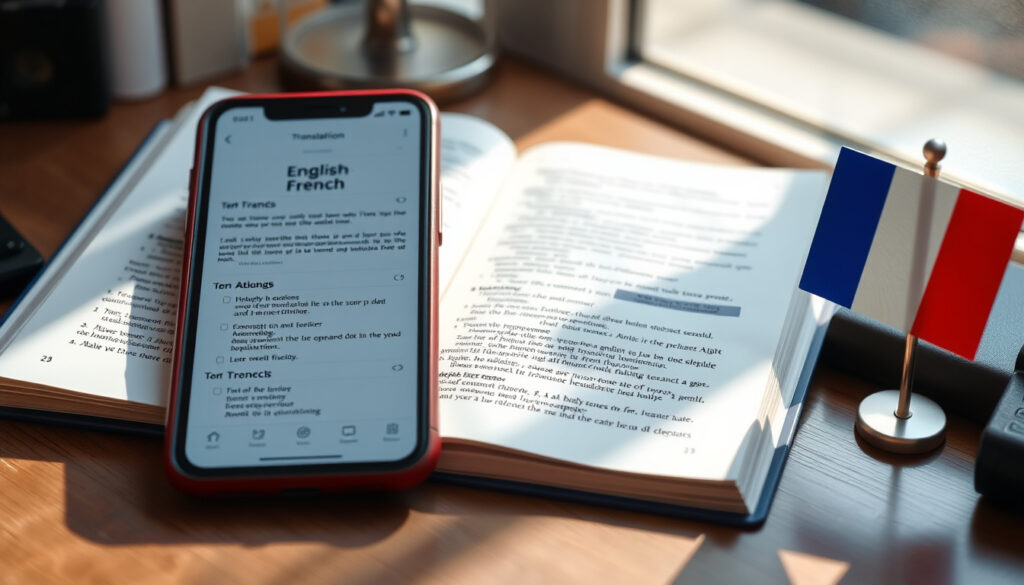
Translate English to French: Tools, Accuracy & Tips
Anyone who’s tried to translate English to French knows that one tool can say “merci beaucoup” and another might stumble on “tu es super.” Finding the right translator isn’t just about speed—it’s about capturing tone, formality, and those untranslatable French expressions that defy a direct word swap, so this guide compares the most popular online tools, tests their accuracy on real sentences, and helps you decide which one fits your next translation task.
Languages supported by Google Translate: 100+ ·
DeepL daily translations: millions ·
Top free translation tools: Google, DeepL, Reverso, Translate.com, Collins ·
Accuracy claim by DeepL: most accurate translator according to internal tests
Quick snapshot
- Free (Google Translate service)
- Supports 100+ languages (ATA (American Translators Association))
- Text, voice, image translation (ATA evaluation)
- Can translate entire documents (ATA feature list)
- AI-powered (DeepL official site)
- Highly accurate (Copycat Cafe review)
- File translation (DeepL features)
- Context-aware suggestions (Copycat Cafe comparison)
- Free (Reverso translation tool)
- Translation with context examples (ATA review)
- Dictionary included (ATA evaluation)
- Supports voice (ATA feature list)
- Free translator (Collins translator page)
- Example sentences (Collins features)
- Synonyms (Collins dictionary)
- Audio pronunciation (Collins example usage)
Four tools, one pattern: each excels in a different area. Google Translate offers the widest language coverage, DeepL claims the highest accuracy, Reverso provides real-context examples, and Collins delivers authoritative definitions. Here’s how they stack up on the numbers that matter for English-to-French translation.
| Tool | Languages supported | Offline mode | Voice input | Context examples |
|---|---|---|---|---|
| Google Translate | 249 (ATA (American Translators Association)) | Yes | Yes | No |
| DeepL | 35 | No | Yes | Limited |
| Reverso Context | 28 | Yes | Yes | Yes |
| Collins Dictionary | 1 (English-French) | No | No | Yes (example sentences) |
The implication: if you need broad language coverage or offline use, Google Translate leads. For best accuracy on nuanced French, DeepL is stronger. Reverso bridges both with context-rich examples, while Collins works best for quick word lookups.
What is the world’s most accurate translator?
The race for the most accurate English-to-French translator comes down to DeepL versus Google Translate, with several independent tests pointing to a clear winner.
How does DeepL compare to Google Translate?
DeepL launched in 2017 and is marketed as “the world’s most accurate translator” (DeepL official website). In tests involving French dialogue with subtleties like filler words, DeepL, Google Translate, and ChatGPT performed best, but DeepL was singled out for superior nuance handling (Copycat Cafe (translation comparison blog)). Google Translate, launched in 2006, supports over 100 languages but is known for occasional errors, especially with idioms and diacritics (Superprof (language learning platform)).
What criteria define translation accuracy?
- Context handling: Does the tool preserve the intended meaning beyond literal words? (Superprof warning on context)
- Idioms and culture: French idioms like “faire la grasse matinée” rarely have direct English equivalents (Superprof (language learning platform)).
- Register (formal vs informal): French distinguishes “tu” and “vous”—machines often miss the cue (Superprof analysis).
- Grammar and diacritics: Accented letters change meaning (e.g., “ou” vs “où”). (Superprof warning)
What this means: no single tool is best for every situation. Accuracy depends on the type of text—simple statements or literary passages—and the tool’s training data.
DeepL’s marketing claim of “world’s most accurate” hasn’t been independently verified by a large-scale academic study. Independent tests on short French dialogues favor DeepL, but for long-form documents with complex register shifts, human translators still outperform all machine options (ATA (American Translators Association) review).
The implication: DeepL leads in nuance but no tool replaces human translators for complex texts.
Is ChatGPT or Google Translate more accurate?
ChatGPT brings conversational context to translation, but Google Translate offers speed and language breadth.
How to test translation accuracy?
A practical method: take a sample French paragraph with idioms, slang, and filler words, then translate it into English using each tool. Copycat Cafe did exactly that and found ChatGPT, Google Translate, and DeepL all performed well, with DeepL slightly ahead on subtle nuances like “euh” (hesitation) and “bon” (discourse marker) (Copycat Cafe evaluation). Independent ATA tests confirm that neural machine translation (NMT) models, which power both ChatGPT and Google Translate, are trained on massive text datasets and depend heavily on input quality—garbage in, garbage out (ATA (American Translators Association)).
What are the strengths of ChatGPT for translation?
- ChatGPT can interpret context better than a straight dictionary, adjusting for tone and register when prompted (Copycat Cafe conversational test).
- It can explain why a translation works, making it a learning tool (Copycat Cafe review).
- However, ChatGPT lacks dedicated translation features like voice input or offline mode (ATA feature comparison).
- It also doesn’t support document upload or instant text-to-speech (ATA evaluation).
The trade-off: ChatGPT is a strong option for dialogue and context-heavy translations, but for quick, straightforward English-to-French conversions, Google Translate’s speed and offline capability win.
What languages are hardest to translate?
French regularly appears on lists of the most complex languages to translate, especially from English.
Why is French considered difficult to translate?
Source lists from translation experts rank French among the top 10 most complex languages for translation (ATA (American Translators Association) commentary). The difficulty stems from grammatical gender, verb conjugations, and the formal/informal pronoun system. A single word like “cœur” (heart) appears in dozens of idioms with no literal English match.
What makes English to French translation challenging?
- False friends: “Actuellement” does not mean “actually”—it means “currently”.
- Register choices: Translating “how are you?” into French requires picking between “comment vas-tu?” (informal) and “comment allez-vous?” (formal) (Superprof (language learning platform)).
- Untranslatable compression: French often uses one word where English needs a phrase (e.g., “dépaysement” = “the feeling of being out of one’s cultural element”).
- Machine translator struggle: Online tools like Google, Microsoft, and Babylon frequently mis-handle homonyms and diacritics (Superprof warning).
Why this matters: even the most accurate translator will stumble on sentences that require cultural knowledge. For business correspondence or creative writing, a human translator remains the gold standard (Superprof recommendation).
“Millions translate from English to French with DeepL every day.”
— DeepL website (DeepL (translation service))
The pattern: French’s complexity means machine translators still miss register and cultural nuance, reinforcing the need for human review.
What does ‘qu’est-ce que c’est’ mean literally?
This classic French phrase trips up many English learners because its literal breakdown differs from its practical meaning.
How to translate ‘qu’est-ce que c’est’ literally?
Merriam-Webster defines the phrase as a fixed expression meaning “what is it?” or “what is that?” (Merriam-Webster (English dictionary)). Literally, it decomposes as: “qu’est-ce que c’est?” = “what is it that it is?” The que inversion and two c’est layers make it a unique construction that has no direct English equivalent.
Is it polite to say ‘de rien’?
Lawless French explains that “de rien” (literally “of nothing”) is a casual response to “merci,” roughly equivalent to “you’re welcome” in informal settings. It is not impolite, but in very formal contexts, French speakers prefer “je vous en prie” (Lawless French (French language educator)).
Do French say ‘de rien’?
Yes, “de rien” is very common among friends and family. According to Lawless French, it is the go-to response for informal “thank you” exchanges, while “avec plaisir” or “je vous en prie” are more polite for strangers or superiors (Lawless French (French language educator)).
What is ‘tout à fait’?
“Tout à fait” translates to “absolutely” or “exactly,” and is used to express strong agreement. It’s one of those phrases a direct word-for-word translation (“all at done”) would ruin, making it a strong test case for any translator’s ability to handle idiomatic French (Lawless French (French language educator)).
If you’re learning French, these short expressions reveal how machine translation still relies on pattern matching. “Tout à fait” will be handled correctly by DeepL and Google, but “de rien” in a formal dialog may get flagged. Knowing the nuance helps you choose when to rely on a tool versus ask a native speaker.
The lesson: common phrases like these highlight the gap between dictionary translation and real-world usage.
What is a French word that can’t be translated?
Some French words have no single English equivalent, forcing translators to use a phrase or lose meaning entirely.
What are examples of untranslatable French words?
Localize Articles highlights “dépaysement” (disorientation when leaving familiar surroundings), “flâner” (to wander with no purpose), and “retrouvailles” (joyful reunion after a long absence) as prime examples (Localize Articles (translation resource)). These words pack cultural concepts that English can only approximate with multiple words.
What is “fattie” in French?
The word “fattie” (a slang term for a fat person) can be translated as “gros” (masculine) or “grosse” (feminine), per Interglot Mobile (Interglot Mobile (dictionary service)). But the register is different—French tends to use “gros” more loosely (“un gros cadeau” = a big gift) so a literal translation without context can be misleading. This illustrates a key challenge: machine translators often pick a direct equivalent without flagging connotation.
The pattern: untranslatable words are a reminder that even the best algorithm lacks shared cultural memory. For creative or emotional texts, software can provide a reasonable draft, but the final polish must be human.
Upsides
- Free tools like Google Translate and Reverso handle basic English-to-French needs instantly.
- DeepL and ChatGPT offer deeper nuance for complex sentences (Copycat Cafe).
- NMT technology improves continuously with more training data (ATA).
- QuillBot and Language IO add grammar checking and business integration (QuillBot).
Downsides
- No machine tool reliably handles French formal vs informal register (Superprof).
- Idioms and culturally specific words like “dépaysement” are often butchered (Localize Articles).
- Offline options are limited; DeepL doesn’t support offline mode (ATA).
- User still needs to verify output for sensitive or formal documents.
How to translate an English document to French
You can turn a full English document into French using any of these methods:
- Upload to Google Translate: Supports PDFs, Word docs, and text files. Free. (Google Translate document upload)
- Use DeepL Pro: Upload files up to 10 MB, keep formatting. Requires paid subscription for heavy use. (DeepL file translation)
- Reverso Context with document upload: Paste text or upload files for context-rich translations. (Reverso file upload)
- Use Immersive Translate: Compare 20+ engines side by side for any text. (Immersive Translate (multi-engine tool))
What to watch: always proofread the output—especially formal correspondence—because no tool can reliably guess if you need “vous” or “tu” for an addressee.
“Google’s service, offered free of charge, instantly translates words, phrases, and web pages between English and over 100 other languages.”
— Google Translate (Google Translate)
For the reader who needs a reliable translation right now: use DeepL for accuracy, Google Translate for speed and range, and Reverso for contextual examples. But if the text contains idioms, cultural references, or requires a specific register, hire a human translator—especially for business or legal documents (Superprof recommendation). The reader should choose DeepL for nuance, Google for speed, and Reverso for context.
For a deeper comparison of accuracy and features, see our guide to the best tools for English to French translation.
Frequently asked questions
Can I use voice translation for English to French?
Yes. Google Translate, DeepL, and Reverso all offer voice-to-text input on mobile apps (ATA voice features).
Is DeepL free for translating longer texts?
DeepL’s free tier allows up to 5,000 characters per translation and unlimited monthly usage. Longer documents need DeepL Pro (DeepL pricing).
Does Reverso provide translations for formal French?
Reverso shows example sentences from real-world sources, including formal texts. However, it doesn’t automatically detect register—you should review the output for “vous” forms (ATA evaluation).
What is the best mobile app for English to French translation?
Google Translate has the widest language support and offline features. DeepL is best for accuracy. Reverso excels at contextual examples. All three are free (ATA comparison).
Are there any offline English to French translators?
Google Translate and Reverso support offline use. DeepL does not (ATA offline availability).
Related reading
More related posts
 Sarah Sherman: SNL Star’s Real Name & Personal Life
 Gabby Barrett: Husband, Kids, Faith, Net Worth
 Seth Jarvis: Injury, Contract, Salary & Personal Life
 TSN Curling Scores Today: Who Won & Schedule Updates
 A Court of Frost and Starlight: Series Role, Characters & More
 La Toya Jackson: Children, Net Worth, and Family Facts
 Ed Warren: The Real Demonologist Behind The Conjuring
 Statistiques de la Liga – 2024/25 Standings, Top Scorers