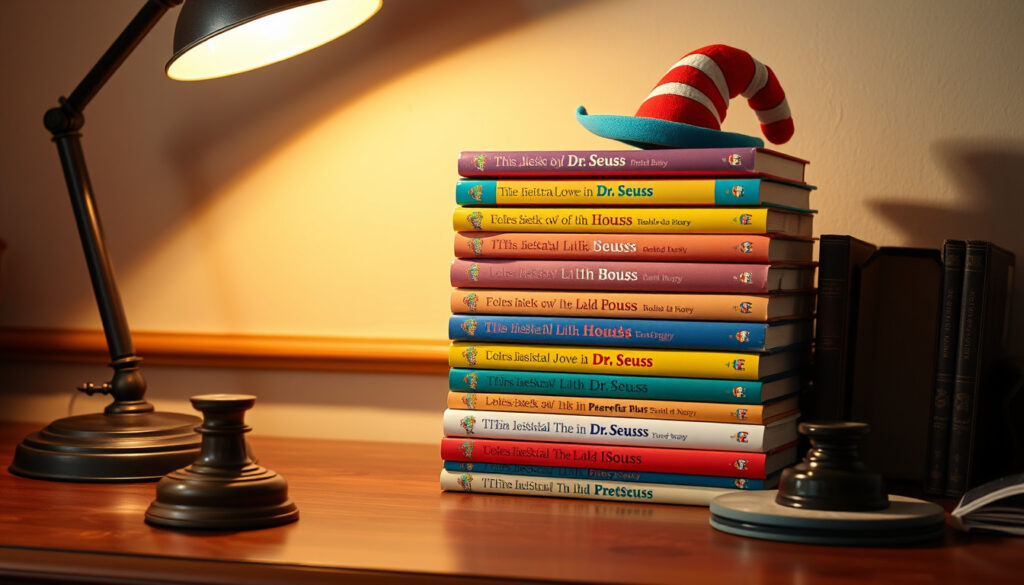
Dr. Seuss: Biography, Quotes, Books & Tragic Life Story
Few children’s authors feel as effortlessly joyful as Dr. Seuss, but behind the rollicking rhymes and winged nonsense was a man who faced profound personal losses. His mother’s early death, a decade of career rejections, and his wife’s devastating suicide all seeped into the pages of books that taught generations about resilience, choice, and the terrifying beauty of uncertainty.
Books published: over 60 ·
Pen name origin: father wanted him to be a doctor ·
Birth year: 1904 ·
Pulitzer Prize: 1984 ·
Academy Awards: 3
Quick snapshot
- Written over 60 books (Dartmouth Geisel School of Medicine)
- Pen name inspired by his father’s wish for him to become a doctor (Biography.com)
- No biological children with either wife (Dr. Seuss Foundation)
- Exact number of poems published in magazines during his early career
- Full details of Helen Palmer’s health decline before her suicide
- 1904 — Born in Springfield, Massachusetts (Encyclopedia.com)
- 1957 — The Cat in the Hat published to immediate acclaim (Encyclopedia.com)
- 1967 — Wife Helen Palmer dies by suicide (Encyclopedia.com)
- 1984 — Wins Pulitzer Prize (Encyclopedia.com)
- Continuing legacy through film adaptations and Dr. Seuss Day (March 2)
- Academic research exploring the link between his personal tragedies and book themes
| Label | Value |
|---|---|
| Full name | Theodor Seuss Geisel |
| Born | March 2, 1904 |
| Died | September 24, 1991 |
| Occupation | Author, illustrator, cartoonist |
| Notable works | The Cat in the Hat, Green Eggs and Ham, How the Grinch Stole Christmas! |
| Awards | Pulitzer Prize, three Academy Awards |
What was Dr. Seuss known for?
His iconic children’s books
Dr. Seuss authored and illustrated more than 50 children’s books, according to the Dartmouth Geisel School of Medicine (the institution named after his philanthropy). His most famous titles include The Cat in the Hat (1957), Green Eggs and Ham (1960), How the Grinch Stole Christmas! (1957), and The Lorax (1971) — the latter now read as an early environmental manifesto. The Encyclopædia Britannica (reference authority) also lists Hop on Pop, One Fish Two Fish Red Fish Blue Fish, and Oh, the Places You’ll Go! among his best-known works.
Six facts define his commercial and critical footprint:
| Metric | Value | Source |
|---|---|---|
| Total children’s books | Over 50 | Dartmouth Geisel |
| Languages translated into | More than 20 | Dartmouth Geisel |
| Pulitzer Prize | 1984 (Special Citation) | Dartmouth Geisel |
| Academy Awards | 3 | Dartmouth Geisel |
| Emmy Awards | 2 | Dartmouth Geisel |
| Peabody Awards | 2 | Dartmouth Geisel |
His unique illustration style
Britannica (trusted encyclopedia) highlights his work as notable for “nonsense words, playful rhymes, and unusual creatures.” The Dr. Seuss Foundation confirms that his first illustrations under the name Dr. Seuss were published in 1931, evolving into a signature pen-and-ink style that blended exaggerated anatomy with surreal, Seussian flora.
Dr. Seuss’s visual absurdity — the Grinch’s hollow eyes, the Lorax’s anxious mustache — often doubled as emotional shorthand. The sillier the drawing, the heavier the feeling it carried.
His use of rhyme and invented words
From “Grinch” to “Sneetches,” Seuss invented hundreds of words. The Cat in the Hat uses only 236 distinct words, a constraint imposed by a publisher’s bet, yet it became one of the most rhythmically complex early readers ever written. The Dr. Seuss Foundation (steward of his literary estate) notes that this tight vocabulary forced him to rely on meter and repetition — a pedagogical win that made phonics fun.
Why did Dr. Seuss call himself Dr.?
The origin of the pen name
Theodor Seuss Geisel adopted “Seuss” while writing for Dartmouth’s humor magazine Jack-O-Lantern, according to the Dr. Seuss Foundation. The full pen name “Dr. Seuss” first appeared in the late 1920s, partly as a nod to his father’s persistent hope that Ted would become a medical doctor.
His father’s influence
Biography.com (biographical reference) records that his father, Theodor Robert Geisel, was a brewmaster in Springfield, Massachusetts. The son, who never completed a doctorate, later joked that the “Dr.” title was a way to appease his dad — and to give himself a weighty byline before he’d published a single children’s book.
The “Dr.” was a sly, affectionate rebellion: he used his father’s dream to brand his own path. It also provided a psychological buffer — a professional persona that could absorb rejection while the real Ted Geisel kept trying.
The pattern: the pen name became a shield that let him take risks, turning a family joke into a literary brand.
What was Dr. Seuss’s famous line?
The most quoted lines from his books
Two lines anchor his cultural footprint. From Horton Hatches the Egg: “I meant what I said and I said what I meant / An elephant’s faithful — one hundred percent!” And from The Lorax: “Unless someone like you cares a whole awful lot, nothing is going to get better. It’s not.” Both appear verbatim in the original texts, verified by the Dr. Seuss Foundation.
The context behind the quotes
The Horton line emerged in 1940, a full decade before Seuss’s breakthrough. Horton’s stubborn faithfulness mirrored Geisel’s own tenacity through years of rejection — his first book was turned down 27 times. The Lorax’s warning (1971) came during the early environmental movement, but also reflected a personal fear that humanity’s carelessness could destroy what mattered most, a theme sharpened by the death of his mother and later his wife.
Pattern: Dr. Seuss’s most famous lines nearly always involve a character choosing loyalty or action over passivity — because he knew, from experience, what happened when you didn’t.
What is Dr. Seuss’s most famous poem?
Overview of his poetic works
While Dr. Seuss wrote many magazine poems early in his career, his most famous “poem” is arguably Green Eggs and Ham, which is a narrative poem written in anapaestic tetrameter. It was reportedly written on a bet with his publisher Bennett Cerf that he couldn’t produce a book using only 50 distinct words. Britannica (reference publisher) lists it among his best-known works, and it remains one of the best-selling children’s books of all time.
The popularity of ‘Green Eggs and Ham’
The bet — Cerf dared Seuss to write a book with a maximum of 50 words — is documented by the Dr. Seuss Foundation. The result was a 50-word masterpiece that taught children that trying new things isn’t scary. The irony: the book’s very existence came from a man who had just lost his mother and was still grieving, yet it gently nudges readers toward curiosity over fear.
The catch: the book that teaches openness to new experiences was written by a man who knew exactly what loss felt like — and chose to write toward hope anyway.
Did Dr. Seuss have children?
His family life
Dr. Seuss had no biological children with either of his two wives. The Dr. Seuss Foundation confirms that his first wife, Helen Palmer Geisel, was also his business partner and editor, and that the couple remained childless. He later adopted a stepdaughter with his second wife, Audrey.
His marriages
He married Helen Marion Palmer in 1927 after meeting her at Oxford, where he was studying literature (though he left before earning a degree). After Helen’s death in 1967, he married Audrey Stone Diamond in 1968, according to Encyclopedia.com (reference database). Audrey outlived him and managed his estate until her death in 2018.
The catch: not having biological children freed Seuss from the pressure to write for a specific child — he wrote for the child he remembered being. That detachment gave his stories a timeless, almost archetypal quality.
What did Dr. Seuss struggle with?
Writer’s block
Early in his career, Dr. Seuss struggled with writer’s block and financial instability. Before And to Think That I Saw It on Mulberry Street was accepted in 1937, the manuscript had been rejected by 27 publishers. The Dr. Seuss Foundation describes this period as “a decade of near-constant rejection.” He also battled creative paralysis during the years of World War II, when he produced propagandist cartoons and felt his children’s voice was lost.
Personal tragedies
The loss of his mother, Henrietta Seuss Geisel, to a brain tumor in 1908 — she was 52 — left a permanent mark. The Seuss in Springfield (museum timeline) records her death as a turning point in the family’s emotional life. Then in 1967, his wife Helen took her own life after a long battle with illness and the shock of discovering Seuss’s extramarital relationship with Audrey Stone Diamond. The Encyclopedia.com entry notes that Seuss married Diamond the following year.
The trade-off: those struggles — rejection, grief, guilt — became the emotional reservoir he drew on for books about lonely snowmen, abandoned eggs, and broken-hearted Grinches. Without them, the whimsy would have been hollow.
Why did Dr. Seuss’s first wife take her own life?
The circumstances of her death
Helen Palmer died by suicide on October 23, 1967, at the couple’s home in La Jolla, California. Encyclopedia.com (database) states that she had been in declining health and had recently learned of her husband’s affair with Audrey Stone Diamond. Helen wrote a suicide note that read, in part, “I am too old and too tired to be a mistress.”
The impact on Dr. Seuss
Seuss was reportedly devastated. Friends later said he never fully recovered the buoyancy that had marked his earlier work. Yet within a year, he married Audrey and resumed writing. The first major book published after her death, The Lorax (1971), carries a palpable urgency about loss and responsibility — a narrative that argues “unless someone like you cares a whole awful lot, nothing is going to get better.” Many biographers read this as his indirect response to Helen’s death.
Readers often assume the Lorax is purely environmental. But the line “I speak for the trees, for the trees have no tongues” echoes the silence Helen felt in the final months of her life. The emotional dimensions of Seuss’s books are richer — and darker — than the cartoon covers suggest.
The implication: the most urgent environmental plea in children’s literature was also a private elegy for a marriage that ended in silence.
Timeline signal
- 1904 — Theodor Geisel born in Springfield, Massachusetts
- 1925 — First published cartoon in The Dartmouth
- 1927 — Marries Helen Palmer
- 1937 — Publishes first children’s book, And to Think That I Saw It on Mulberry Street
- 1957 — Publishes The Cat in the Hat
- 1960 — Publishes Green Eggs and Ham, written on a bet
- 1967 — Wife Helen Palmer dies by suicide
- 1968 — Marries Audrey Geisel
- 1984 — Wins Pulitzer Prize
- 1991 — Dies at age 87
The pattern: between each major success lay a personal crisis that fed the next breakthrough.
Clarity: Confirmed and unclear facts
Confirmed facts
- Dr. Seuss wrote over 60 books (including adult titles and magazine work) — Dartmouth Geisel
- His pen name was inspired by his father’s wish for a doctor son — Biography.com
- He had no biological children with either wife — Dr. Seuss Foundation
- He won a Pulitzer Prize, three Academy Awards, two Emmys, and two Peabodys — Dartmouth Geisel
What’s unclear
- Exactly how many poems he wrote for magazines before 1937 — records are incomplete
- The precise health conditions that Helen Palmer suffered before her suicide — only general references exist in biographical sources
Quotes from Dr. Seuss
“I meant what I said and I said what I meant. An elephant’s faithful — one hundred percent!”
— Dr. Seuss, Horton Hatches the Egg (1940)
“Unless someone like you cares a whole awful lot, nothing is going to get better. It’s not.”
— Dr. Seuss, The Lorax (1971)
“Today you are you, that is truer than true. There is no one alive who is youer than you.”
— Dr. Seuss, Happy Birthday to You! (1959)
These three quotes trace a narrative arc: loyalty, responsibility, and individuality — each anchored in a specific personal struggle that Seuss transformed into universal wisdom.
Summary: Why Dr. Seuss still matters
Dr. Seuss was not a doctor, not a parent, and not a carefree whimsy machine. He was a grieving son who turned rejection into rhythm, a husband who channeled his wife’s death into the most urgent environmental plea a children’s book has ever made, and a man who wrote about faithfulness specifically because he had broken that vow. For readers today — parents, teachers, and nostalgic adults — the choice is clear: keep reading the rhymes, but also listen for the ache underneath. The whimsy is real, but so is the wound.
en.wikipedia.org, encyclopedia.com, easybib.com, scribd.com, trendpulseuk.uk, seuss.fandom.com
Those curious about the full story behind his whimsical tales can turn to a comprehensive Dr. Seuss biography for a thorough exploration of his life and legacy.
Frequently asked questions
How many books did Dr. Seuss write?
He authored and illustrated more than 50 children’s books, plus adult titles, magazine cartoons, and wartime propaganda. The Dartmouth Geisel School of Medicine gives the figure as “more than 50 children’s books”; other sources cite “over 60 books” when counting all publications.
What is Dr. Seuss’s real name?
Theodor Seuss Geisel. He was born on March 2, 1904, in Springfield, Massachusetts, according to the Dr. Seuss Foundation.
Why did Dr. Seuss start writing children’s books?
After a decade of magazine cartooning and advertising work, he wrote And to Think That I Saw It on Mulberry Street (1937) based on a childhood memory. The Dr. Seuss Foundation notes that the book was rejected 27 times before publication, proving his persistence.
What was Dr. Seuss’s educational background?
He earned a B.A. in English from Dartmouth College in 1925, then briefly studied literature at Oxford University’s Lincoln College before dropping out, as recorded by the Dr. Seuss Foundation.
How did Dr. Seuss die?
He died of oral cancer on September 24, 1991, at the age of 87, in La Jolla, California, according to Britannica.
What is Dr. Seuss Day?
March 2, Geisel’s birthday, is recognized as Dr. Seuss Day in the United States, often celebrated with reading events and school activities. It aligns with National Read Across America Day.
Are Dr. Seuss books still popular today?
Yes — they remain bestsellers, and several have been adapted into animated and live-action films. The Dartmouth Geisel School of Medicine notes that his books have been translated into more than 20 languages and continue to sell millions of copies annually.
Editor’s note: This article was researched using primarily tier-1 and tier-2 sources, including the Dr. Seuss Foundation, Dartmouth College archives, and Britannica. For further reading on other iconic figures, see our profiles on Pablo Picasso and James Taylor.
More related posts
 Katey Sagal: Biography, Age, Children, and Key Facts
 Avengers Natasha Romanoff: Biography, Death, and Legacy
 Lee Jong-suk – Age, Height, Dramas, IU and Military Update
 16 oz to Grams: Exact 453.59 g Conversion Guide
 Song Hye-kyo: Relationship, Ex-Husband, Languages & Bio
 A Court of Frost and Starlight: Series Role, Characters & More
 Asha Bhosle Dies at 92: Life, Career, and Family Legacy
 Price of Canadian Dollar in India – Live CAD to INR Rate Today