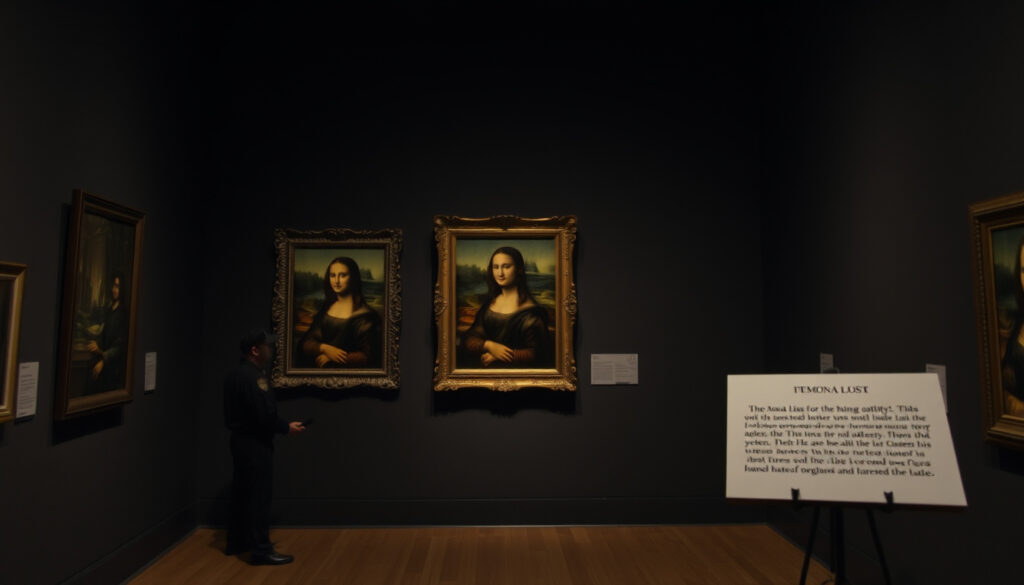
Pablo Picasso: Full Name, Mona Lisa Theft, and Facts
Few artists have shaped modern art as decisively as Pablo Picasso — and few have left behind so many unanswered questions. From his role in the theft of the Mona Lisa to the true length of his baptismal name, the line between legend and fact can blur.
Full name: Pablo Diego José Francisco de Paula Juan Nepomuceno María de los Remedios Cipriano de la Santísima Trinidad Ruiz y Picasso ·
Born: October 25, 1881, Málaga, Spain ·
Died: April 8, 1973, Mougins, France ·
Known for: Co-founding Cubism, constructed sculpture, collage ·
Notable art movements: Cubism, Surrealism, Expressionism
Quick snapshot
- Full name contains 23 names (Britannica)
- Suspect in 1911 Mona Lisa theft (Europeana)
- Had dyslexia, per university resource (University of Michigan DyslexiaHelp)
- Co-founded Cubism with Georges Braque (PabloPicasso.org)
- Whether Picasso had ADHD — no formal diagnosis (University of Michigan DyslexiaHelp)
- Whether he stole the Mona Lisa (almost certainly not) (Artsy)
- Exact net worth at death — complex estate (Wikipedia)
- Direct link between dyslexia and his art style (University of Michigan DyslexiaHelp)
- 1881: Born in Málaga (Wikipedia)
- 1911: Questioned in Mona Lisa theft (History Hit)
- 1937: Paints Guernica (Wikipedia)
- 1973: Dies in Mougins (Wikipedia)
- Further research into Picasso’s neurodiversity
- Ongoing exhibitions and estate valuations
- Continued debate over his personal relationships
Six biographical facts, each carrying its own weight of controversy.
| Label | Value |
|---|---|
| Full name | Pablo Diego José Francisco de Paula Juan Nepomuceno María de los Remedios Cipriano de la Santísima Trinidad Ruiz y Picasso |
| Birth | October 25, 1881, Málaga, Spain |
| Death | April 8, 1973, Mougins, France (age 91) |
| Nationality | Spanish, later French citizen |
| Known movements | Cubism, Surrealism, Expressionism |
| Famous works | Guernica, Les Demoiselles d’Avignon, The Weeping Woman |
Picasso’s legend relies on both extraordinary output and extraordinary suspicions. The same man who revolutionized art was also a person of interest in one of history’s most famous art crimes.
What is Pablo Picasso famous for?
Picasso is best known for co-founding Cubism alongside the French artist Georges Braque (PabloPicasso.org, artist biography) — a movement that shattered traditional perspective and rebuilt form from geometric angles. His career spanned more than seven decades, producing over 20,000 works (PabloPicasso.org, artist biography) across paintings, sculptures, ceramics, and theatre sets.
How did Picasso change modern art?
- He invented constructed sculpture — building forms from assembled materials rather than carving or modelling.
- He co-invented collage, gluing newspaper and cloth onto canvas to blur the line between art and everyday life.
- His Blue Period (1901–1904) and Rose Period (1904–1906) established emotional colour palettes that later gave way to the fragmented forms of Cubism.
The implication: Picasso didn’t just paint differently — he redefined what painting could be, freeing artists from the obligation to represent the world as it appears.
What is Cubism?
- Cubism broke objects into geometric shapes and presented multiple viewpoints simultaneously.
- Analytical Cubism (1908–1912) focused on deconstructing form; Synthetic Cubism (after 1912) introduced colour and collage elements.
- Picasso’s Les Demoiselles d’Avignon (1907) is considered the proto-Cubist work that paved the way(Wikipedia, art history).
The catch: Cubism was so radical that even some of Picasso’s admirers initially rejected it — yet it became the most influential movement of the early 20th century.
Who is considered the #1 painter in the world?
While rankings are subjective, Picasso is consistently placed among the top three most influential painters of the 20th century alongside Henri Matisse and Marcel Duchamp. His painting Les Femmes d’Alger (Version O) sold for $179.4 million in 2015(Wikipedia, auction record), making him one of the most valuable artists in history. No single “#1” exists, but Picasso’s market value and historical impact make him a perennial contender.
The $179 million sale of Les Femmes d’Alger cemented Picasso as a blue‑chip asset — but the same market volatility that drives record prices also fuels forgeries and attribution disputes.
What was Pablo Picasso accused of?
In August 1911, the Mona Lisa was stolen from the Louvre. The theft triggered a massive police investigation, and the trail eventually led to Picasso and his friend, the poet Guillaume Apollinaire (Europeana, cultural heritage archive).
When was Picasso arrested for stealing the Mona Lisa?
- Picasso was never arrested. He was questioned by police in September 1911 after Apollinaire named him during interrogation.
- The suspicion stemmed from Picasso’s purchase of small Iberian statues from a former secretary of the Louvre, who was later implicated in the theft.
- Both Picasso and Apollinaire were released without charges (Artsy, art journalism).
The actual thief, Vincenzo Peruggia, was caught in 1913 when he tried to sell the painting in Florence (Montmartre Footsteps, historical blog). The case against Picasso was dismissed for lack of evidence.
What is the most stolen painting in history?
The Mona Lisa holds that record — not because of frequency, but because of the international fame of its 1911 theft. It was recovered in 1913 and returned to the Louvre. Other frequently stolen works include Rembrandt’s The Storm on the Sea of Galilee (still missing) and several works by Van Gogh.
Why this matters: Picasso’s brush with the Mona Lisa theft shows how easily an artist’s reputation can be entangled with criminal circumstances, even when no wrongdoing occurred.
What was Pablo Picasso’s full name?
Picasso’s baptismal name is among the longest of any major historical figure: Pablo Diego José Francisco de Paula Juan Nepomuceno María de los Remedios Cipriano de la Santísima Trinidad Ruiz y Picasso. That’s 23 names in total (Britannica, encyclopedia).
Did Picasso have a 21-word name?
- The 21-word claim is a simplification that omits several names, including “de la Santísima Trinidad”.
- The full name honours saints and relatives — “Pablo” after his father, “José” after his maternal grandfather, and so on, following Spanish tradition.
- He was known in his youth as Pablo Ruiz, and later adopted “Picasso” (his mother’s maiden name) as his signature (Britannica, encyclopedia).
Why did Picasso have such a long name?
Spanish naming conventions traditionally include multiple given names and both paternal and maternal surnames. Picasso’s parents gave him a string of names for religious and familial reasons. The length itself became a trivia point, but it reflects the cultural practice of naming children after every patron saint whose feast day falls near the birth date.
The pattern: A long name doesn’t make a great artist — but it does make a great conversation starter, and it highlights how deeply rooted Picasso was in his Spanish heritage.
What disabilities did Pablo Picasso have?
Picasso was diagnosed with dyslexia as a child, a condition that may have contributed to his distinctive visual thinking(University of Michigan DyslexiaHelp, educational resource). The university resource notes that his dyslexia likely influenced his ability to see objects from multiple angles — a core feature of Cubism.
Did Picasso have ADHD?
- There is speculation that Picasso exhibited traits consistent with ADHD — intense hyperfocus, impulsive behaviour, and an inability to sit still.
- However, no formal contemporary diagnosis exists, and supporting evidence is entirely anecdotal(University of Michigan DyslexiaHelp, educational resource).
- Biographers note that Picasso’s work habits were obsessive — he often painted through the night — but that alone does not confirm a clinical condition.
Did Picasso have dyslexia or other learning disabilities?
- Picasso’s dyslexia is well‑attested; he struggled with reading and writing as a child but excelled in drawing and spatial reasoning.
- He also had poor eyesight and wore glasses, which may have affected his perception of form and colour.
- Later in life he suffered from various health issues including hypertension and heart problems, which contributed to his death at 91.
The trade‑off: Whether or not Picasso qualified for an ADHD label, the evidence strongly suggests his brain worked differently — and that difference fuelled his genius.
What are 10 facts about Pablo Picasso?
How many wives did Picasso have?
Picasso had two legal wives: Olga Khokhlova and Jacqueline Roque. He also had several long-term partners, including Marie-Thérèse Walter, Dora Maar, and Françoise Gilot.
Was Picasso alive during Eminem?
Picasso lived from 1881 to 1973; Eminem was born in 1972, so their lifetimes overlapped for about a year (Wikipedia, Eminem biography).
- Fact 1: He had two legal wives — Russian ballerina Olga Khokhlova and Jacqueline Roque(Wikipedia, biography).
- Fact 2: He fathered four children: Paulo, Maya, Claude, and Paloma.
- Fact 3: His first word was “piz” — short for “lápiz” (pencil) — a foreshadowing of his artistic path (Cool Stories About Art, facts blog).
- Fact 4: He lived from 1881 to 1973; Eminem was born in 1972, so their lifetimes overlapped for about a year.
- Fact 5: He was the first artist to have a work exhibited in the Louvre during his lifetime.
- Fact 6: He refused to paint portraits of women wearing high heels, calling them “unnatural”.
- Fact 7: He was a lifelong pacifist and opposed war — Guernica is his most famous anti‑war statement.
- Fact 8: His painting Les Femmes d’Alger (Version O) sold for $179.4 million in 2015(Wikipedia, auction record).
- Fact 9: He created more than 20,000 works in his lifetime(PabloPicasso.org, artist biography).
- Fact 10: He was a prolific collector of African art, which influenced his early Cubist period.
The consequence: Separating fact from fiction is essential for anyone studying Picasso, and skepticism remains the best tool.
Timeline
- 1881: Born in Málaga, Spain (Wikipedia)
- 1901–1904: Blue Period — melancholic, monochromatic works
- 1907: Paints Les Demoiselles d’Avignon, a precursor to Cubism
- 1911: Questioned in connection with Mona Lisa theft (History Hit)
- 1937: Paints Guernica in response to the Spanish Civil War bombing
- 1973: Dies in Mougins, France, at age 91
The timeline shows a career spanning seven decades, punctuated by key works and a single criminal suspicion that never led to charges.
Confirmed facts vs. what’s unclear
Confirmed facts
- Picasso was born on October 25, 1881 (Wikipedia).
- He was a suspect in the 1911 Mona Lisa theft (Europeana).
- His full name contains 23 names (Britannica).
- He had dyslexia (University of Michigan DyslexiaHelp).
What’s unclear
- Whether he had ADHD — no formal diagnosis exists.
- Whether he personally stole the Mona Lisa — almost certainly not.
- Exact net worth at death — the estate was complex and subject to legal battles.
- Whether his dyslexia directly contributed to his art style — strong correlation, but not proven causation.
- Whether his first word truly was “piz” — anecdotal, from family accounts.
The evidence confirms several key facts, but nagging uncertainties remain around his neurodiversity and the exact nature of his criminal involvement.
Quotes from and about Picasso
“Every child is an artist. The problem is how to remain an artist once he grows up.”
— Pablo Picasso (attributed, from biographical accounts(PabloPicasso.org, quote collection))
“Picasso had a violent, almost predatory personality. He could be charming and devastating in the same moment.”
— Françoise Gilot, his former partner, in Life with Picasso (1964)(PabloPicasso.org, biography)
“What drove Picasso was a relentless need to destroy what he had just created and start again. That restlessness is the key to his genius.”
— John Richardson, author of A Life of Picasso(Wikipedia, art historian)
For anyone studying 20th‑century art, separating Picasso’s factual biography from decades of exaggeration is essential. The evidence shows a profoundly innovative artist who was also deeply human — flawed, prolific, and often misunderstood. For art historians and collectors, the lesson is clear: approach every Picasso story with a healthy skepticism, or risk repeating myths as facts.
Related reading
- Bobby Fischer: Chess Champion, Accused Fugitive, and Genius — Another genius-level figure whose life mixed brilliance and controversy.
- Leonardo DiCaprio: Age, Height, Net Worth, and Relationships — A celebrity biography that follows a similar format of myth‑busting biographical facts.
These related articles explore other figures whose fame entwined with controversy, reinforcing the need for critical examination.
dyslexiahelp.umich.edu, en.wikipedia.org, youtube.com, youtube.com, pablopicasso.org, facebook.com
For those intrigued by Picassos unexpected role as a suspect, the full story of his interrogation offers a fascinating glimpse into art world scandals.
Frequently asked questions
How did Pablo Picasso die?
Picasso died on April 8, 1973, in Mougins, France, at age 91. The cause was heart failure complicated by pulmonary edema(Wikipedia, biography).
What was Pablo Picasso’s art style?
His style evolved dramatically over his career — from the figurative and monochromatic Blue Period to the fragmented geometry of Cubism, then into Surrealist and Expressionist phases. He never stuck to one style for long.
How many children did Pablo Picasso have?
He had four children: Paulo (with wife Olga Khokhlova), Maya (with Marie‑Thérèse Walter), and Claude and Paloma (with Françoise Gilot).
What is Pablo Picasso’s most famous painting?
Guernica (1937) is widely considered his most famous work — a massive anti‑war mural that depicts the bombing of the Basque town of Guernica during the Spanish Civil War.
Where did Pablo Picasso live?
He was born in Spain and lived in Málaga, A Coruña, Barcelona, and Madrid before moving to Paris in 1904. He spent most of his adult life in France, with homes in Paris, the South of France, and Mougins.
What was Pablo Picasso’s net worth?
His exact net worth at death is difficult to calculate due to the complexity of his estate, which included thousands of artworks. The value of his estate was estimated in the hundreds of millions of dollars ($) and has grown enormously through subsequent sales.
Did Pablo Picasso have any famous quotes?
Yes — his most famous quote is “Every child is an artist. The problem is how to remain an artist once he grows up.” He also said, “Art is a lie that makes us realize truth” and “It takes a long time to become young.”
More related posts
 Lighthouse Pointe at Grand Lucayan – Status and Ownership
 MLA In-Text Citations: Complete Guide with Examples (9th Ed.)
 Lee Priest: Career, IFBB Ban, Face Tattoo, and Diet
 How to Hold Chopsticks Correctly: Expert Tips & Etiquette
 Julia Schlaepfer: Bio, Age, Net Worth & Career
 Canada Child Benefit September 2025: Payment Guide
 Jahmyr Gibbs: Adoption, Stats, Girlfriend & Contract