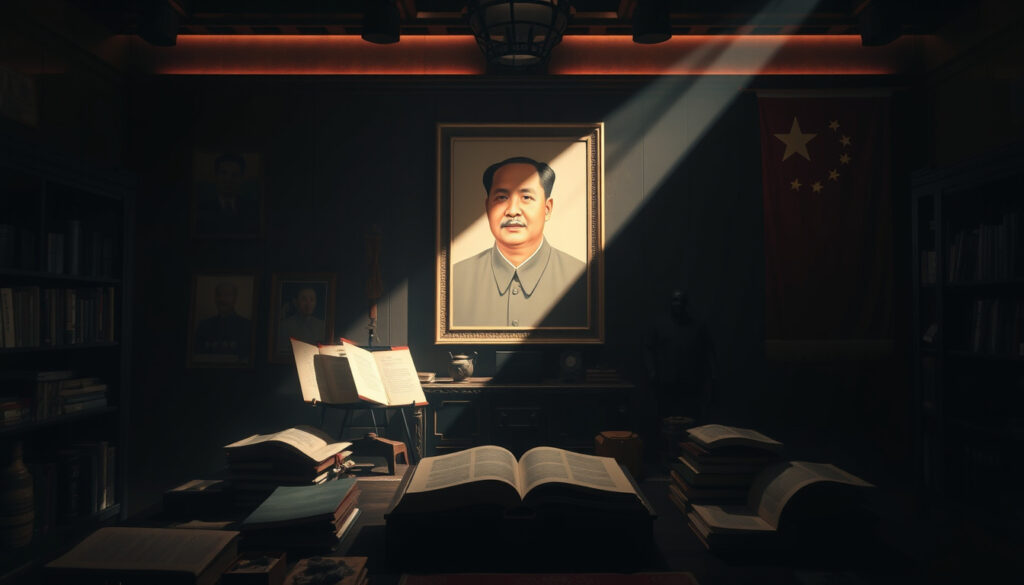
Mao Zedong: Competing Narratives of China’s Founder
Few leaders in history divide opinion quite like Mao Zedong. To China’s official narrative, he is the founding father who ended a century of foreign domination; to many outside China, he is responsible for some of the worst famines and political purges of the 20th century.
Born: December 26, 1893 ·
Died: September 9, 1976 ·
Title: Chairman of the Chinese Communist Party (1943–1976) ·
Known for: Founding the PRC, Great Leap Forward, Cultural Revolution
Quick snapshot
- Born December 26, 1893, in Shaoshan, Hunan (Encyclopaedia Britannica (reference work)).
- Proclaimed the People’s Republic of China on October 1, 1949 (Encyclopaedia Britannica).
- Died September 9, 1976, from ALS (Encyclopaedia Britannica).
- Exact number of deaths caused by Mao’s policies (NPR (public radio)).
- Whether Lin Biao actually plotted to assassinate Mao (Wikipedia (open encyclopedia)).
- Full details of Mao’s final health decline. (NPR (public radio))
- Full extent of Mao’s involvement in specific atrocities (NPR (public radio)).
- 1958–1961: Great Leap Forward famine (BBC History (public broadcaster)).
- 1966–1976: Cultural Revolution purges (BBC News (international news)).
- 1971: Lin Biao death in plane crash (Wikipedia).
- Continued debate over Mao’s legacy as China balances modernization with revolutionary history (Lowy Institute (think tank)).
- Scholarly research may further clarify mortality estimates and the Lin Biao plot. (Lowy Institute (think tank))
Ten key facts, one pattern: Mao’s life spans the arc from peasant revolution to totalitarian rule, with achievements and catastrophes intertwined.
| Label | Value |
|---|---|
| Full name | Mao Zedong (also Mao Tse-tung) |
| Born | December 26, 1893, Shaoshan, Hunan, China |
| Died | September 9, 1976, Beijing, China |
| Cause of death | Amyotrophic lateral sclerosis (ALS) |
| Height | 5 ft 10 in (178 cm) |
| Spouses | He Zizhen (1928–1939), Jiang Qing (1939–1976) |
| Children | 10 (including Mao Anying, Mao Anqing, Li Min, Li Na) |
| Political party | Chinese Communist Party |
| Title | Chairman of the Central Committee of the CCP (1943–1976) |
| Known for | Founding the PRC, Great Leap Forward, Cultural Revolution, Maoism |
What is Mao Zedong best known for?
Founding of the People’s Republic of China
Mao led the Chinese Communist Party to victory in the Chinese Civil War and proclaimed the PRC on October 1, 1949 (Encyclopaedia Britannica (reference work)). He served as chairman of the People’s Republic from 1949 to 1959 and remained chairman of the CCP until his death (Encyclopaedia Britannica summary).
Great Leap Forward
From 1958 to 1961, Mao pushed rapid industrialization and collectivization. The campaign resulted in widespread famine – historian Roderick MacFarquhar called it “the worst famine in recorded history” (BBC History (public broadcaster)).
Cultural Revolution
Launched in 1966, the Cultural Revolution aimed to purge “impure” elements and revive revolutionary fervor. Millions were forced into manual labor, and tens of thousands were executed (BBC News (international news)).
Maoism as a political theory
Mao developed a variant of Marxism–Leninism that emphasized peasant revolution and continuous class struggle. Maoism influenced communist movements globally, from Nepal to Peru (Encyclopaedia Britannica).
Does China still respect Mao Zedong?
Official reverence in modern China
The Chinese government officially venerates Mao as a founding father and revolutionary hero. His portrait still hangs in Tiananmen Square and government buildings (NPR (public radio)). The CCP’s 1981 resolution stated that Mao’s contributions to the revolution far outweigh his mistakes (Wikipedia (open encyclopedia)).
Younger generation’s views
Surveys suggest younger Chinese are more critical but are still taught to respect his role in national unification (Lowy Institute (think tank)).
China’s official narrative celebrates Mao’s achievements while downplaying the death toll – a selective memory that many outside China find hard to reconcile with the facts.
Memorials and museums
Mausoleums, statues, and museums dedicated to Mao remain popular tourist sites. The official line, as summarized by Britannica, is that Mao’s actions were laudable until summer 1957 and harder to defend afterward (Encyclopaedia Britannica (reference work)).
Who tried to assassinate Mao?
Lin Biao and the alleged coup plot
Lin Biao, Mao’s designated successor, reportedly plotted to assassinate Mao in 1971. After the plot was allegedly exposed, Lin died in a plane crash in Mongolia while fleeing (Wikipedia (open encyclopedia)).
Details of the failed assassination attempt
According to official Chinese accounts, Lin Biao planned a coup but the plan was discovered. However, some historians question the official version, noting that the evidence is circumstantial (Wikipedia).
Aftermath of the Lin Biao incident
The incident marked a turning point in the Cultural Revolution, leading to a purge of Lin’s associates and a shift in Mao’s trust toward the military (Encyclopaedia Britannica (reference work)).
The Lin Biao affair remains one of the Cold War’s enduring mysteries – a coup that may never have been intended, or a genuine assassination attempt that failed by hours.
The implication: until more evidence surfaces, the Lin Biao incident will remain a subject of historical speculation.
Was Mao Zedong good or bad?
Positive aspects: unification, literacy, land reform
Mao was credited with ending foreign domination, unifying China, and improving literacy and life expectancy. His land reforms gave land to formerly landless peasants (Encyclopaedia Britannica (reference work)).
Negative aspects: famine, repression, human rights abuses
Mao’s policies caused tens of millions of deaths from famine, persecution, and political violence. The BBC states he was “responsible for the disastrous policies of the Great Leap Forward and the Cultural Revolution” (BBC History (public broadcaster)). NPR reports that the official verdict is controversial because Mao caused tens of millions of deaths through economic mismanagement and political terror (NPR (public radio)).
Historical assessment and competing views
Scholars debate whether his achievements outweigh the human cost. In China, he is officially considered 70 percent right and 30 percent wrong (NPR). In the West, he is often condemned as a dictator.
The table below contrasts the two dominant narratives.
| Aspect | Official Chinese narrative | International critique |
|---|---|---|
| National unification | Ended foreign domination and civil war | Used brutal force to consolidate power |
| Economic policy | Great Leap Forward aimed at industrialization | Caused worst famine in history (1958–61) |
| Social change | Land reform empowered peasants | Cultural Revolution persecuted intellectuals |
| Life expectancy | Improved from ~35 to ~65 years during Mao’s era | Life expectancy gains partly offset by famines |
| Human rights | Emphasized collective good over individual rights | Mass surveillance, torture, executions widespread |
The catch: both narratives are true in part, and the judgment involves weighing irreconcilable values – national independence against individual liberty, order against tolerance.
What is Mao Zedong’s cause of death?
Official cause: amyotrophic lateral sclerosis (ALS)
Mao died on September 9, 1976, from ALS (Lou Gehrig’s disease) and related complications (Encyclopaedia Britannica (reference work)).
Last years and health decline
In his final years, Mao suffered from Parkinson’s disease and motor neuron decline, but the full details of his health decline remain unclear (Encyclopaedia Britannica).
Mao Zedong’s full name and pronunciation
His full name was Mao Zedong, also romanized as Mao Tse-tung. Pronunciation: /maʊ zə dɒŋ/ (MAO ZUH-dong).
Mao Zedong’s height and early life
He was about 5 feet 10 inches (178 cm) tall. Born in 1893 in Shaoshan, he worked as a librarian before becoming a revolutionary (Encyclopaedia Britannica).
The pattern: even basic biographical facts like cause of death are well-established, but the deeper story – how much his policies killed – remains contested.
Upsides
- Unified China after decades of civil war and foreign exploitation (Encyclopaedia Britannica (reference work)).
- Land reforms gave millions of poor farmers land (Encyclopaedia Britannica).
- Literacy rates rose from about 20% to over 65% during his rule (BBC History (public broadcaster)).
- Maoism continues to inspire anti-colonial movements worldwide (Encyclopaedia Britannica).
Downsides
- Great Leap Forward caused a famine that killed an estimated 20–45 million people (NPR (public radio)).
- Cultural Revolution led to persecution of millions, with tens of thousands executed (BBC News (international news)).
- Authoritarian crackdowns suppressed dissent and free speech (Encyclopaedia Britannica).
- Persistent one-party system after Mao’s death limited political freedom (Encyclopaedia Britannica).
Timeline of Mao Zedong’s life
- : Born in Shaoshan, Hunan (Encyclopaedia Britannica (reference work)).
- : Co-founded the Chinese Communist Party (Encyclopaedia Britannica summary).
- : Led the Long March, gaining prominence (Encyclopaedia Britannica summary).
- : Proclaimed the People’s Republic of China (Encyclopaedia Britannica).
- : Great Leap Forward leads to severe famine (BBC History (public broadcaster)).
- : Cultural Revolution purges perceived enemies (BBC News (international news)).
- : Lin Biao dies after alleged coup plot (Wikipedia (open encyclopedia)).
- : Mao dies of ALS; power struggle ensues (Encyclopaedia Britannica).
The timeline shows a life of rapid ascent, catastrophic policy, and enduring mystery.
Clarity: what’s confirmed, what’s unclear
Confirmed facts
- Mao was born December 26, 1893, and died September 9, 1976 (Encyclopaedia Britannica (reference work)).
- He was chairman of the CCP from 1931 to 1976 and chairman of the PRC from 1949 to 1959 (Encyclopaedia Britannica summary).
- He launched the Great Leap Forward and the Cultural Revolution (BBC History (public broadcaster)).
- Lin Biao died in a plane crash in 1971 (Wikipedia (open encyclopedia)).
What’s unclear
- Exact number of deaths caused by Mao’s policies (NPR (public radio)).
- Whether Lin Biao actually plotted to assassinate Mao – the official version may be incomplete (Wikipedia).
- Details of Mao’s final health decline are not fully documented.
The gap between confirmed facts and what remains unclear underscores the ongoing debate over Mao’s true legacy.
Voices on Mao Zedong
The Chinese people have stood up.
– Mao Zedong, 1949 proclamation of the PRC
The Great Leap Forward led to the worst famine in recorded history.
– Roderick MacFarquhar, historian, quoted in BBC History
Mao is a great revolutionary and the founding father of New China.
– Official Chinese government statement, as reported by Lowy Institute
Mao unleashed a totalitarian regime that destroyed the lives of tens of millions.
– Jung Chang, author of Mao: The Unknown Story
For anyone trying to understand modern China, the choice is clear: either accept the official narrative that Mao was 70 percent right, or weigh the evidence that his policies caused tens of millions of preventable deaths. The truth is that both frames contain uncomfortable facts. Readers must reconcile these competing narratives to understand the full impact of Mao’s rule.
britannica.com, sg.news.yahoo.com, kids.britannica.com, thehistoryprofessor.com, dlab.epfl.ch, kids.britannica.com
Readers interested in the competing narratives of Mao’s rule will find a detailed breakdown in Mao Zedongs biography and legacy.
Frequently asked questions
What was the Long March and why was it important?
The Long March (1934–1935) was a military retreat by the Chinese Communist Army to evade the Nationalist forces. Mao emerged as the party’s leader during the march, which established his reputation as a revolutionary strategist (Encyclopaedia Britannica summary).
What is Maoism?
Maoism is a variant of Marxism–Leninism that emphasizes the role of the peasantry in revolution and continuous class struggle after the takeover of power (Encyclopaedia Britannica (reference work)).
How many people died under Mao’s rule?
Estimates vary widely, from 20 million to 45 million deaths due to famine, political persecution, and forced labor. The exact number remains unclear (NPR (public radio)).
What is the Cultural Revolution?
A sociopolitical movement launched by Mao in 1966 to purge “bourgeois” elements from Chinese society. It led to widespread chaos, persecution of intellectuals, and the destruction of cultural heritage (BBC News (international news)).
Why did Mao launch the Great Leap Forward?
Mao aimed to rapidly industrialize China and catch up with Western economies by collectivizing agriculture and emphasizing steel production. The campaign backfired, causing mass famine (BBC History (public broadcaster)).
What is Mao’s legacy in China today?
He is officially celebrated as the founder of the PRC, but his policies are selectively praised. The government maintains his portrait in public spaces while downplaying the human cost (Lowy Institute (think tank)).
Is China still communist under Mao’s ideology?
China officially follows socialism with Chinese characteristics under the CCP. Maoist ideology remains a foundational reference, but economic reforms since 1978 have moved the country toward a mixed economy (Encyclopaedia Britannica (reference work)).
More related posts
 Ath. Bilbao vs Real Madrid: El Viejo Clásico History & Stats
 Why Is Shannon Elizabeth on OnlyFans? Her Life, Career, Net Worth
 Forbes Connections Hint Today – NYT #1041 Spoiler-Free Clues
 Evan Rodrigues: Wife, Career, Contract, and Life with the Panthers
 Katrina Kaif Biography: Age, Religion, Husband, Net Worth & More
 Elizabeth Montgomery: Life and Legacy of Bewitched
 Laura Benanti: Tony Winner, TV Star, Melania Trump Impersonator