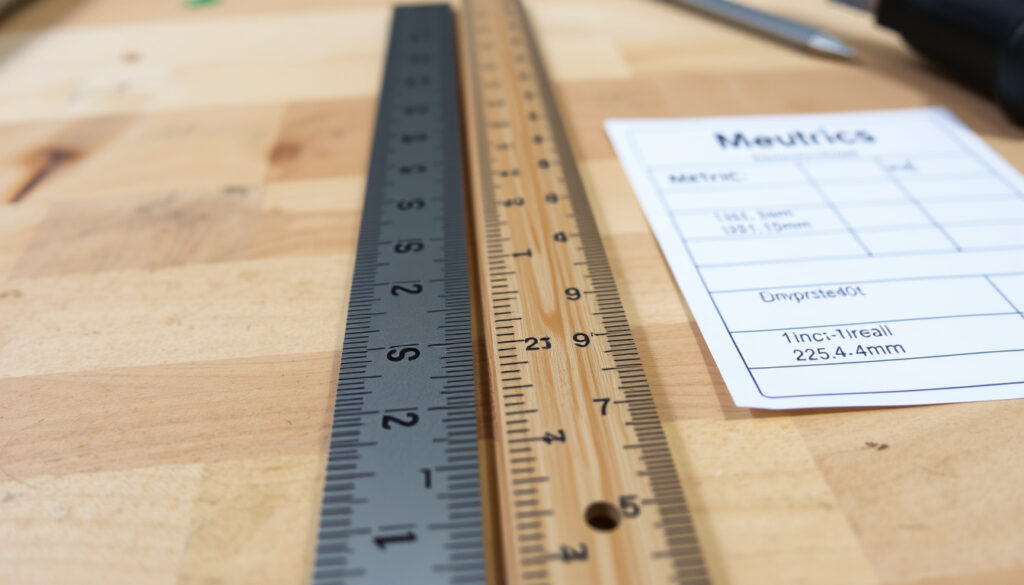
1 Inch to MM – Exact Conversion Guide and Tables
One inch equals exactly 25.4 millimeters. This precise conversion factor, established by international agreement in 1959, bridges the gap between the US customary system and the metric system used throughout most of the world. Whether you are working in engineering, printing, construction, or simply need to convert measurements for a project, understanding this conversion is fundamental.
The definition of one inch as exactly 25.4 mm eliminated centuries of confusion between the US customary inch and the British imperial inch. Today, manufacturers, trade partners, and standards organizations worldwide operate under this unified standard, ensuring compatibility across borders and industries.
How Many mm in 1 Inch?
The answer is straightforward: 1 inch = 25.4 mm. This is not an approximation but an exact definition established by international treaty. The conversion works in both directions, though the reverse calculation produces a repeating decimal.
One inch equals exactly 25.4 millimeters. No rounding is required for the primary conversion. The factor 25.4 is precise by international definition, not measurement.
Quick Reference Grid
| Measurement | Symbol | Equivalent | Notes |
|---|---|---|---|
| Inch | in or ″ | 25.4 mm | Exact by definition |
| Millimeter | mm | 0.0393701 in | SI unit |
| 1/2 inch | ½ | 12.7 mm | Common fastener size |
| 1/4 inch | ¼ | 6.35 mm | Quarter inch |
Essential Insights
- The conversion from inches to millimeters is exact and requires no approximation when converting whole inches.
- The inch was redefined in 1959 to align precisely with the metric system, ending historical discrepancies between US and UK measurements.
- Precision matters significantly in manufacturing and engineering, where even small errors can cause parts to fail assembly.
- Reverse conversion (mm to inches) produces a repeating decimal and requires careful handling for high-precision applications.
- The definition is maintained by the National Institute of Standards and Technology (NIST) and the International Bureau of Weights and Measures (BIPM).
Inches to mm Conversion Formula
Converting inches to millimeters follows a simple mathematical relationship. The formula requires multiplying the number of inches by 25.4 to obtain the equivalent measurement in millimeters.
The Basic Formula
Millimeters = Inches × 25.4
This formula applies universally. For example, 6 inches equals 6 × 25.4 = 152.4 mm. The calculation works for whole numbers and fractional values alike.
Reverse Conversion: mm to Inches
To convert millimeters to inches, divide by 25.4:
Inches = Millimeters ÷ 25.4
For instance, 100 mm ÷ 25.4 ≈ 3.937 inches. This reverse calculation produces a repeating decimal, so precision depends on how many decimal places you retain.
When converting 10 mm to inches, the result is approximately 0.3937 inches. The more decimal places retained, the more accurate the conversion becomes for precision work.
Common Inch Fractions to mm
Fractional inch measurements are common in construction, woodworking, and manufacturing. These conversions multiply the fractional value by 25.4 to yield exact millimeter equivalents.
Half Inch, Quarter Inch, and Eighth Inch
Common fractions appear frequently in everyday measurements. A half inch (½) equals 12.7 mm exactly. A quarter inch (¼) equals 6.35 mm. An eighth inch (⅛) equals 3.175 mm.
For quick mental conversions, remember that half an inch is approximately 13 mm, quarter inch is about 6 mm, and an eighth inch is roughly 3 mm. These rounded figures work well for non-precision tasks.
Inch to mm Conversion Table
| Fraction | Decimal (inches) | Millimeters (exact) |
|---|---|---|
| 1/64 | 0.015625 | 0.3969 |
| 1/32 | 0.03125 | 0.79375 |
| 1/16 | 0.0625 | 1.5875 |
| 1/8 | 0.125 | 3.175 |
| 1/4 | 0.25 | 6.35 |
| 3/8 | 0.375 | 9.525 |
| 1/2 | 0.5 | 12.7 |
| 5/8 | 0.625 | 15.875 |
| 3/4 | 0.75 | 19.05 |
| 7/8 | 0.875 | 22.225 |
| 1 | 1.0 | 25.4 |
Historical Definition and the 1959 Agreement
Prior to 1959, the US customary inch and the British imperial inch had slightly different values. This discrepancy created significant problems for manufacturers producing parts that needed to fit together across international borders.
In 1959, representatives from the United States, United Kingdom, Canada, Australia, New Zealand, South Africa, and the International Bureau of Weights and Measures signed an agreement establishing the international yard at exactly 0.9144 meters. From this definition, one inch was derived as exactly 25.4 millimeters.
Why This Matters for Precision Manufacturing
The standardization resolved persistent issues in precision manufacturing. Before the agreement, bolts and machined parts often failed to fit when produced in different countries. Today, global supply chains rely on this unified definition to ensure compatibility across the National Institute of Standards and Technology and international partners.
Precision and Common Errors
Understanding precision is essential when converting between measurement systems. While the conversion factor 25.4 is exact by definition, practical measurements introduce limitations based on the tools used.
What Is Established and Certain
| Established Information | Context |
|---|---|
| 1 inch = 25.4 mm exactly | Defined by international agreement since 1959 |
| Conversion factor is exact | No rounding required for whole inch values |
| Definition maintained by NIST and BIPM | Official standards organizations |
Common Mistakes to Avoid
- Using pre-1959 inch values, which differed between US and UK standards
- Rounding 25.4 to 25, which introduces errors in precision work
- Confusing the US survey foot with the international foot
- Retaining too few decimal places when converting millimeters back to inches
Applications in Engineering and Industry
The inch-to-millimeter conversion serves critical functions across multiple industries. Understanding these applications highlights why precision matters in everyday practice. Per a més informació, consulta la nostra guia per Convertire 74 kW in CV.
Manufacturing and Fasteners
Machined parts, bolts, and fasteners rely on exact conversions. A tolerance of just 0.010 inches (0.254 mm) can determine whether components fit or fail. Fastener conversion tables help workers select the correct sizes across measurement systems.
Printing and Paper Sizes
Many printing specifications reference fractional inch measurements. Half-inch drill bits measure 12.7 mm, and paper plate dimensions often use imperial units despite the predominantly metric industry. The Bureau International des Poids et Mesures provides guidance on maintaining consistency across different measurement traditions.
Pipelines and Infrastructure
Pipe specifications frequently use inch measurements. A “36-inch pipeline” refers to nominal diameter, not actual measurement, yet conversions still require precision for fittings and connectors. Engineering teams must account for these nuances when working with conversion resources and industry standards.
Metric Standards and SI Units
The SI system (Système International d’Unités) provides the foundation for modern measurement. The meter serves as the base unit of length, with the millimeter representing one-thousandth of a meter.
US law, including the Metric Conversion Act and subsequent amendments, mandates metric preference in federal activities. However, legacy imperial measurements persist in many industries due to existing infrastructure, equipment, and workforce familiarity.
Sources and Standards Organizations
Several authoritative bodies maintain measurement standards and provide official conversion factors. The National Institute of Standards and Technology serves as the primary authority for US measurement standards, while the International Bureau of Weights and Measures oversees global standards.
The inch is defined as exactly 25.4 mm. This definition is maintained by the International Bureau of Weights and Measures.
- NIST (National Institute of Standards and Technology) — Maintains US measurement standards and provides official conversion factors
- BIPM (International Bureau of Weights and Measures) — Oversees the SI system internationally
- CGPM (General Conference on Weights and Measures) — Sets international metric standards
Summary
One inch equals exactly 25.4 millimeters, a definition established by international agreement in 1959. This conversion factor applies universally across engineering, manufacturing, and construction. To convert inches to millimeters, multiply by 25.4. To convert millimeters to inches, divide by 25.4, keeping in mind the result will be a repeating decimal requiring careful handling for precision work.
Understanding the distinction between exact definitions and practical measurements helps avoid common errors. For related conversions and measurement tools, see the guide on temperature conversions and volume measurements.
Frequently Asked Questions
How many inches are in 1 millimeter?
One millimeter equals approximately 0.0393701 inches. This is calculated by dividing 1 by 25.4, which produces a repeating decimal.
Why is 1 inch exactly 25.4 mm?
The value was established by international agreement in 1959. Countries including the US, UK, Canada, and others agreed to define the international yard as exactly 0.9144 meters, from which one inch was derived as exactly 25.4 mm.
Is 1 inch 25.4 mm or an approximation?
One inch equals exactly 25.4 mm by definition. This is not an approximation but an exact conversion factor established by treaty and maintained by standards organizations like NIST and BIPM.
How do you convert fractions of an inch to millimeters?
Multiply the fractional inch value by 25.4. For example, 3/4 inch equals 0.75 × 25.4 = 19.05 mm. The conversion remains exact regardless of the fraction size.
What is the formula for converting inches to mm?
The formula is: millimeters = inches × 25.4. For reverse conversion: inches = millimeters ÷ 25.4.
Are there any recent changes to the inch-mm conversion?
No changes have occurred since the 1959 agreement. The standards have remained stable, and the conversion factor of exactly 25.4 mm per inch remains in effect globally.
What is the US survey foot and how does it differ?
The US survey foot is slightly different from the international foot used today. The survey foot is based on older US customary definitions and may cause confusion in precision measurements. Most applications now use the international foot.
More related posts
 Malachi Barton: Career, Dating History & Verified Facts
 Prince William: Biography, Family, Role, and Recent News
 Billy Ray Cyrus: Net Worth, Health, and Family Feud
 Che Guevara: Cuban Revolutionary, Death, and Legacy
 Comme Chez Soi Magog – Menu, Reviews & Booking Guide
 20 Pounds in kg: Exact Conversion & Everyday Uses
 Registre des Entreprises Quebec: Register Your Business
 30 Degrees Celsius to Fahrenheit – Exact Conversion Guide