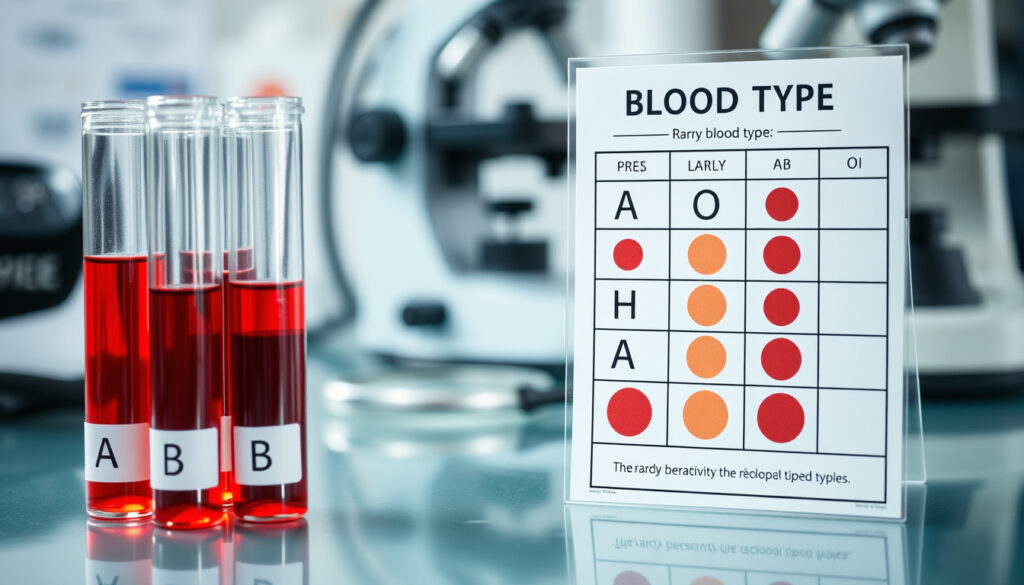
Blood Types: Rarity, Health, and Questions Answered
You might not think about your blood type until a donation form or a medical form asks. But behind the letters and plus signs — A+, O-, AB- — lies a surprisingly detailed system that determines everything from who you can donate to to how common your type really is.
Most common blood type globally: O+ (approx. 37% of population) ·
Rarest blood type globally: AB- (less than 1% of population) ·
Most common blood type in Ireland: O+ (47% of population) ·
Rarest blood type in Ireland: AB- (1% of population) ·
Number of main blood types: 8 (A+, A-, B+, B-, AB+, AB-, O+, O-)
Quick snapshot
- Four groups: A, B, AB, O
- Determined by A and B antigens on red blood cells
- Universal donor: O-
- Universal recipient: AB+
- Present (+) or absent (-)
- Creates 8 main blood types
- Rh- can only receive Rh- blood
- Important for pregnancy compatibility
- O+ most common globally (37%)
- AB- rarest globally (<1%)
- O+ most common in Ireland (47%)
- AB- rarest in Ireland (1%)
- O- can donate to all types
- O+ can donate to Rh+ types
- AB+ can receive from all types
- Compatibility rules are based on ABO and Rh
Seven key facts about blood type distribution, compiled from Irish Blood Transfusion Service (Ireland’s national blood service) and American Red Cross (the leading U.S. emergency blood provider), show the global and Irish picture side by side.
| Fact | Value |
|---|---|
| Most common blood type worldwide | O+ |
| Rarest blood type worldwide | AB- |
| Most common blood type in Ireland | O+ (47%) |
| Rarest blood type in Ireland | AB- (1%) |
| Universal donor | O- |
| Universal recipient | AB+ |
| Number of main blood groups | 8 |
Which is the rarest blood type?
Among the eight major blood types, AB- stands out as the rarest. Globally, less than 1% of the population has it, according to the NHS Blood and Transplant (the UK’s national blood service). In Ireland, the rarity is the same: AB- makes up just 1% of the population, as reported by the Irish Blood Transfusion Service (IBTS).
What are the top 3 rarest blood types?
- AB- (rarest) — less than 1% globally
- B- — about 1-2% of the population
- A- — about 4-6% depending on region
These percentages come from the American Red Cross (the leading U.S. blood collection organization). The exact ranking holds for Ireland as well, with AB- at the bottom.
Is O+ a rare blood group?
No — O+ is actually the most common blood type. It accounts for roughly 37% of the global population and 47% of the Irish population, per IBTS (Ireland’s national blood bank). Calling it rare would be a mistake; it’s the type you’re most likely to have.
Blood banks in Ireland must maintain a constant supply of AB- even though it’s held by only 1% of the population. A shortage of AB- can delay surgeries and emergency transfusions for the roughly 45,000 people in Ireland who depend on it.
What blood type do most Irish have?
If you’re in Ireland, there’s a good chance you’re O+. The Irish Blood Transfusion Service (the national blood donation authority) reports that O+ makes up 47% of the population. A 2021 peer-reviewed study from Health Science Reports (Browne et al.) found ABO phenotype distribution of A 29.82%, B 12.02%, O 54.95%, and AB 3.21% in a modern Irish cohort, with 83% RhD positive.
What are the most common blood types in Ireland?
Ordered by frequency, the leading types are O+ (47%), A+ (27%), B+ (10%), and AB+ (3%). The same study confirmed expected ABO group prevalences of A 31%, B 11%, O 56%, and AB 3%.
What are the rare blood types in Ireland?
- AB- (1% of population)
- B- (1-2% of population)
- A- (around 4% of population)
These figures come from IBTS (Ireland’s blood transfusion service). A secondary Irish data source also notes O+ as the most common among Irish donors.
The pattern: Ireland’s blood type distribution closely mirrors European averages, but O+ is slightly above the global norm. For blood banks, this means a steady supply of O+ is easier to maintain, but the rarest types like AB- require special donor recruitment drives.
What’s the healthiest blood type?
The short answer: there is no definitive evidence that any blood type is “healthiest.” While some studies have found small differences in disease risk — for example, type O may have a lower risk of blood clots, and type A may have a slightly higher risk of stomach cancer — these associations are not strong enough to declare a winner. The American Red Cross (the U.S. blood authority) states that blood type is primarily relevant for transfusion compatibility, not overall health.
Is there a healthiest blood type?
No mainstream medical organisation endorses the idea of a “healthiest” blood type. The consensus is that lifestyle factors — diet, exercise, smoking, and genetics — far outweigh any blood-type influence on health outcomes.
Which blood type lives longest?
Some observational studies have suggested that people with type O may have a slight longevity advantage, but the results are inconsistent and often not adjusted for socioeconomic factors. A NHS (UK national health authority) review of the research concluded that no strong link exists between blood type and life expectancy. The variation is less than a few years at most and is not clinically meaningful.
What blood type is prone to ADHD?
Some research has explored a possible link between the ABO gene and attention-deficit/hyperactivity disorder (ADHD). A PubMed / NIH (peer-reviewed medical database) study found a correlation between certain ABO genotypes and ADHD symptoms, but the findings are preliminary and not replicated in large-scale trials.
What is the correlation between ABO blood type gene and attention-deficit?
The ABO gene, which determines blood type, also influences the expression of other proteins in the brain. One small study suggested that individuals with type A or AB might have a slightly higher risk of ADHD, but the effect size was small and the study had limited sample size. The National Institute of Mental Health (the leading U.S. research agency) does not list blood type as a known risk factor for ADHD.
The catch: The evidence is too weak to recommend any screening or avoidance based on blood type. Genetics, environment, and prenatal factors play far larger roles.
Why can’t O+ donate to everyone?
O+ blood can only be given to recipients with a positive Rh factor. That’s because the Rh antigen on O+ red cells would trigger an immune response in an Rh-negative person. The American Red Cross (the largest U.S. blood supplier) explains that O- is the universal donor for red cells because it lacks both A, B, and Rh antigens.
What are the rules for blood donation compatibility?
- O- can donate to all types (universal donor)
- O+ can donate to Rh-positive types (A+, B+, AB+, O+)
- AB+ can receive from all types (universal recipient)
- Rh- can only receive from Rh- donors
These rules are standardised by the Irish Blood Transfusion Service (Ireland’s national blood service). The NHS Blood and Transplant (the UK’s blood service) adds that compatibility is essential to prevent transfusion reactions.
O+ is the most common type, but it cannot be used for Rh-negative patients — who make up about 17% of the Irish population. That’s why hospitals always need O- on hand for emergencies and for newborns, where Rh compatibility is critical.
What was Jesus’s blood type?
There is no verifiable scientific evidence for Jesus’s blood type. Blood type is inherited from parents, and no biological sample from Jesus has ever been authenticated. Claims based on the Shroud of Turin or other relics are not accepted by mainstream science. The Encyclopaedia Britannica (a trusted reference source) notes that relic studies are speculative and lack proper chain of custody.
Are there scientific analyses of the relics of Jesus?
Some researchers have claimed to find blood on the Shroud of Turin and the Sudarium of Oviedo, and have typed it as AB. However, these studies are heavily disputed, the samples may be contaminated, and the relics themselves have not been dated to the first century. The PubMed Central (the NIH’s free full-text archive) contains no peer-reviewed paper that confirms the blood type of a historical figure from two millennia ago.
Why this matters: This question often arises in online discussions, but it’s a reminder that blood type is a biological trait that cannot be determined without a verified biological sample. For the historical record, the answer is simply: unknown.
Six blood types, one pattern: the rarest are the ones with both uncommon antigens and negative Rh factor. Below is a comparison of global and Irish distribution.
| Blood Type | Global Frequency | Irish Frequency |
|---|---|---|
| O+ | 37% | 47% |
| A+ | 28% | 27% |
| B+ | 8% | 10% |
| AB+ | 3% | 3% |
| O- | 6% | 5% |
| A- | 4% | 4% |
| B- | 1% | 1-2% |
| AB- | <1% | 1% |
The implication: Ireland’s O+ rate is significantly higher than the global average, which means the national blood supply is heavily dependent on O+ donors. But the rarest type, AB-, remains at 1% in both datasets, underscoring the need for targeted recruitment.
Eight blood types, two basic rules: the ABO group and the Rh factor govern who can give to whom. Here’s the compatibility matrix.
| Blood Type | Can Donate To | Can Receive From |
|---|---|---|
| O- | All types | O- |
| O+ | O+, A+, B+, AB+ | O+, O- |
| A- | A-, A+, AB-, AB+ | A-, O- |
| A+ | A+, AB+ | A+, A-, O+, O- |
| B- | B-, B+, AB-, AB+ | B-, O- |
| B+ | B+, AB+ | B+, B-, O+, O- |
| AB- | AB-, AB+ | All Rh- types |
| AB+ | AB+ | All types |
What we know and what’s still unclear
Confirmed facts
- AB- is the rarest blood type in the ABO/Rh system
- O+ is the most common blood type globally and in Ireland
- Blood type distribution varies by geographic region and ethnicity
- O- is the universal donor for red blood cells
- Blood type is determined by genetics (ABO and Rh genes)
What’s unclear
- Whether any blood type is associated with overall better health or longer life
- The causal link between ABO type and ADHD (only correlations exist)
- Jesus’s blood type (no verifiable data)
- Whether blood type directly influences susceptibility to most diseases
O positive is the most common blood group in Ireland, making up 47% of the population. AB negative is the least common, at 1%.
Irish Blood Transfusion Service (Ireland’s national blood donation service)
O negative red blood cells can be given to patients of any blood type. That’s why O negative is known as the universal donor.
American Red Cross (the largest humanitarian blood supplier in the U.S.)
ABO is the letter part of a blood type. Rh is the positive or negative part. Together they give us the eight main blood types.
The ABO gene has been studied for possible links to ADHD, but the evidence is preliminary and not strong enough to draw conclusions.
PubMed / NIH (the U.S. National Library of Medicine’s peer-reviewed research database)
Blood types are far more than a static label on a medical chart. They influence transfusion compatibility, shape donation strategies, and even spark curiosity about health and history. For Ireland, where O+ dominates and AB- is a precious rarity, the practical takeaway is clear: blood banks need donors of every type, especially those with the rarest groups. The next time you see your blood type, think of it as a key — one that opens doors for others, but only if the lock fits.
sundayreport.uk, health.ec.europa.eu, mediaroar.uk, civicviewpoint.net, scienceinsights.org, findthenorm.com, scienceinsights.org
Frequently asked questions
What are the 8 main blood types?
The eight main blood types are A+, A-, B+, B-, AB+, AB-, O+, and O-. They are formed by combining the ABO group (A, B, AB, O) with the Rh factor (positive or negative).
Is AB negative the rarest blood type?
Yes, AB- is the rarest among the eight common types. Globally, less than 1% of the population has it. In Ireland, it’s also 1%.
Can O+ donate blood to anyone?
No. O+ can only donate to people with a positive Rh factor (A+, B+, AB+, O+). It cannot be given to Rh-negative recipients.
What is the Rh factor in blood?
The Rh factor is a protein on the surface of red blood cells. If you have it, you’re Rh positive; if not, you’re Rh negative. It’s the “+” or “-” in your blood type.
Do blood types affect pregnancy?
Yes, if an Rh-negative mother carries an Rh-positive baby, her immune system can make antibodies that attack the baby’s red blood cells. This is preventable with an injection of Rh immunoglobulin.
Can blood type change over time?
Blood type is genetically determined and does not change during a person’s lifetime. Rare exceptions include bone marrow transplants or certain cancers, but these are not natural changes.
What is the universal donor blood type?
O- is the universal donor for red blood cells because it lacks A, B, and Rh antigens. AB+ is the universal recipient for red cells because it can accept all types.
More related posts
 Bilal Abbas Khan: Age, Dramas & Personal Life
 Lee Jong-suk – Age, Height, Dramas, IU and Military Update
 Toronto Raptors vs Bulls Player Stats (March 18, 2026)
 Vanessa Williams: Biography, Scandal, Hit Songs, and Current Life
 Ed Warren: The Real Demonologist Behind The Conjuring
 NYT Mini Crossword Answers Today: Hints & Solutions
 Gordie Howe: Mr. Hockey’s Legacy, Records, and Gretzky Debate
 Tucker Carlson: Fox News Exit, Politics, and New Network