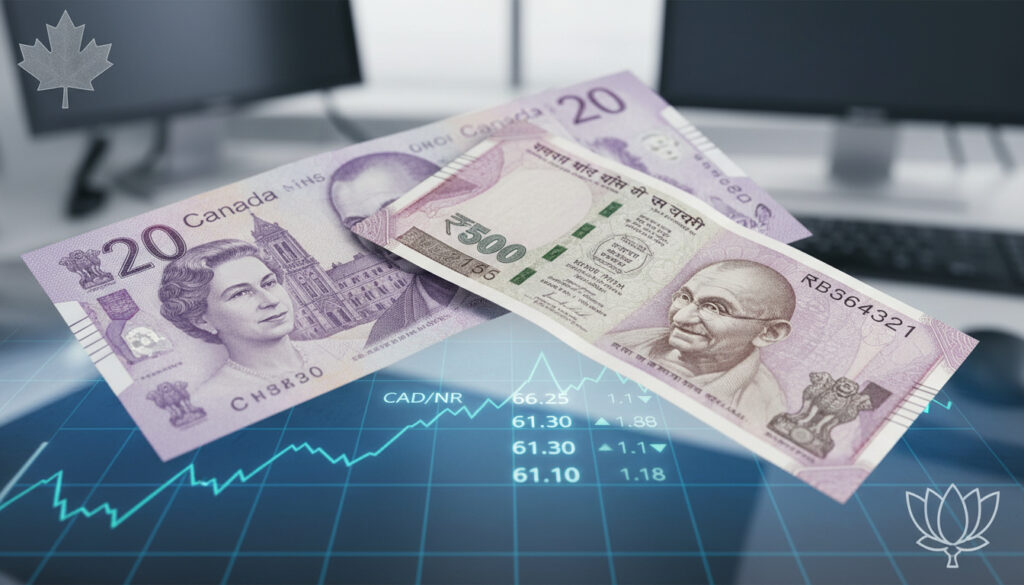
Price of Canadian Dollar in India – Live CAD to INR Rate Today
The Canadian dollar currently trades between 66.50 and 68.30 Indian rupees in global foreign exchange markets. Live data from April 4, 2026, reveals significant variation across providers, with mid-market benchmarks diverging substantially from retail rates available to consumers in India.
For Indian students in Canada, families receiving remittances, and businesses engaged in bilateral trade, these fluctuations directly impact purchasing power. The range reflects not only interbank trading levels but also the margins applied by currency exchange platforms, banks, and specialized forex services operating across both jurisdictions.
Understanding the mechanics behind these numbers requires examining real-time provider data, historical volatility patterns, and the economic fundamentals linking the oil-sensitive Canadian dollar to the Reserve Bank of India’s monetary policy framework.
What is the current CAD to INR exchange rate?
- Live rates from Wise show 68.02 INR per CAD, while Xe quotes 68.30 INR for the same timestamp.
- BookMyForex lists the interbank rate at 66.51 INR, marking a decline of 0.94% from the previous trading session.
- Promotional offerings such as Remitly’s first-transfer rate of 67.40 INR demonstrate how marketing incentives create temporary deviations from standard pricing.
- Retail spreads vary by up to 5 INR between the lowest digital platform quote (62.33 INR via Revolut) and premium mid-market indicators.
- Currency notes in India command higher buy rates (67.40 INR) compared to forex card loadings (66.72 INR) due to physical cash handling costs.
- Wire transfer rates (67.07 INR) typically position between card-based and physical cash conversion tiers.
| Provider | Service Type | Rate (INR per CAD) | Source Date |
|---|---|---|---|
| BookMyForex | Interbank Reference | 66.51 | April 4, 2026 |
| BookMyForex | Forex Card (Buy) | 66.72 | April 4, 2026 |
| BookMyForex | Wire Transfer | 67.07 | April 4, 2026 |
| BookMyForex | Currency Notes (Buy) | 67.40 | April 4, 2026 |
| Remitly | Promotional First Transfer | 67.40 | Live |
| Wise | Mid-Market | 68.02 | Live |
| Xe | Mid-Market | 68.30 | Live |
| Investing.com | Market Rate | 66.48 | Live |
| Revolut | Digital Platform | 62.33 | Live |
Where to get the best CAD exchange rates in India?
Digital Platforms versus Traditional Banking Channels
Specialized foreign exchange services consistently outperform airport counters and unlicensed street vendors. Wise and Instarem provide transparent mid-market rates with clearly disclosed conversion fees, while Western Union maintains extensive physical networks for cash pickup options across Indian cities.
The listed exchange rate represents only one component of conversion costs. Transfer fees, service charges, and recipient bank deductions can alter the effective rate by 1-3 INR. Comparing the final rupee amount received—not just the headline rate—reveals the true cheapest option for your specific transfer amount.
India-Focused Retail Forex Services
BookMyForex offers structured products for the Indian market, distinguishing between forex card rates (66.72 INR buy), wire transfers (67.07 INR), and physical currency notes (67.40 INR). Remitly targets new customers with promotional pricing at 67.40 INR for initial transfers, though subsequent transactions typically revert to standard spreads.
Regional Considerations within Canada
Exchange rate consistency varies minimally across Canadian provinces, though service availability differs. Those conducting transactions from Manitoba should verify local provider access, noting the 431 Area Code Canada – Manitoba Location and History Guide for regional telecommunications context when contacting forex service desks.
What is the CAD to INR forecast?
Short-Term Volatility Indicators
Recent trading data indicates relatively constrained volatility, ranging from 0.41% over 90 days to 0.64% over 7 days. These figures suggest the currency pair is experiencing a period of consolidation rather than dramatic directional movement. The 30-day average of 67.50 INR sits above the 90-day mean of 66.55 INR, indicating gradual Canadian dollar strengthening through early 2026.
No specific 2025 CAD-to-INR forecasts appear in current market data. Long-term currency predictions require macroeconomic modeling beyond the scope of live exchange rate reporting. Current volatility metrics reflect historical patterns, not predictive guarantees of future ranges.
Policy Divergence Factors
Interest rate differentials between the Bank of Canada and the Reserve Bank of India significantly influence forward expectations. Commodity price fluctuations, particularly crude oil benchmarks to which the Canadian dollar maintains historical correlation, introduce additional variables that complicate directional betting on this currency pair.
What do historical CAD to INR rates reveal?
Historical charts from Xe document a 90-day trading range spanning 64.84 to 68.52 INR, with the current rate resting near the upper boundary of this channel. This positioning suggests the Canadian dollar has appreciated approximately 5.5% against the rupee over the past quarter.
While 12-month charting tools track mid-market movements, comprehensive historical archives comparing retail bank rates versus forex service rates remain proprietary and unavailable for direct public analysis. Retail consumers should request rate history directly from their chosen provider.
Monthly Average Progression
The ascending trajectory from the 90-day average (66.55 INR) to the 30-day average (67.50 INR) reflects sustained buying pressure on the Canadian dollar. Whether this trend continues depends on forthcoming monetary policy announcements from both central banks and evolving trade balance figures between the two nations.
How has the CAD to INR rate moved over time?
- : Interbank rate closes at 66.51 INR, representing a 0.94% decline from the previous session according to BookMyForex data.
- Past 7 days: Rates oscillated between 67.74 and 68.52 INR, averaging 68.19 with 0.64% volatility.
- Past 30 days: The broader range extended from 66.34 to 68.52 INR, with a mean value of 67.50.
- Past 90 days: The quarterly low reached 64.84 INR against a high of 68.52, averaging 66.55 across the period.
What should you know about rate certainty?
Established Data
- Mid-market rates fluctuate between 66.50 and 68.30 INR
- Provider spreads create 1-5 INR variations from interbank levels
- RBI intervenes in forex markets to manage rupee volatility
- Commodity prices correlate with Canadian dollar strength
- Forex cards offer superior rates to physical currency notes
Uncertain Information
- Exact timing and scale of future RBI market interventions
- Specific bank margins without direct rate inquiry
- Long-term directional predictions for 2025 and beyond
- Daily closing rates prior to market opening
- Official RBI reference rates (not provided in current data)
What economic factors drive the Canadian dollar price in India?
The Canadian dollar maintains a documented correlation with global oil prices, given Canada’s status as a major energy exporter. When crude benchmarks rise, the CAD typically strengthens against the rupee, though this relationship has decoupled temporarily during periods of risk-off sentiment in global markets.
Interest rate policies create divergent pressures. The Bank of Canada’s overnight rate decisions relative to the Reserve Bank of India’s repo rate adjustments influence capital flows between the jurisdictions. Higher Canadian yields generally attract Indian portfolio investment, increasing demand for CAD.
Trade and remittance volumes form the practical backbone of this currency pair. Indian imports of Canadian lentils, potash, and educational services create steady CAD demand, while remittances from the Indian diaspora in Canada supply rupee liquidity. Businesses managing logistics between the nations often coordinate currency exchanges with shipping schedules, utilizing resources such as the UPS Canada Phone Number – Official Service Numbers and Hours for supply chain synchronization.
Sources and market credibility
Volatility data indicates 0.41% fluctuation over 90 days and 0.64% over 7 days, suggesting relatively stable trading conditions with moderate intraday movement.
Xe Currency Data, April 2026
The Reserve Bank of India intervenes to manage volatility, though official reference rates are published separately through RBI channels and may differ from retail market indicators.
BookMyForex Market Analysis
Mid-market rates represent the midpoint between buy and sell prices on global currency markets, serving as benchmarks rather than executable retail prices.
Wise Exchange Methodology
Summary
The Canadian dollar trades between 66.50 and 68.30 Indian rupees as of April 2026, with specific execution rates depending on provider selection and product type. BookMyForex interbank data shows 66.51 INR, while retail services range from 66.72 for forex cards to 68.30 on mid-market platforms. Consumers should compare total transfer costs—including fees and margins—across specialized forex services, digital platforms, and banking channels before executing conversions. Short-term volatility remains moderate at under 0.7%, though long-term directional forecasts remain unavailable in current market data.
Frequently asked questions
How do I convert CAD to INR online?
Register with platforms like Wise or BookMyForex, complete KYC with PAN and passport, enter the CAD amount, compare the final INR payout after fees, and confirm the transfer. Funds typically credit within 1-2 business days.
What is the difference between buy and sell rates?
The buy rate is the price you pay to purchase Canadian dollars (higher number). The sell rate is what you receive when converting CAD to rupees (lower number). The spread between them represents the provider’s margin.
Why does the Canadian dollar rate change daily?
Forex markets operate continuously, responding to oil price shifts, interest rate announcements from the Bank of Canada and RBI, and global risk sentiment. These variables adjust supply and demand balances continuously.
Is it better to carry CAD cash or use a forex card in India?
Forex cards offer better rates (approximately 66.72 INR) and security compared to cash (67.40 INR). Cards also provide locked-in rates, while cash rates fluctuate with daily market movements.
What documents are required to buy Canadian dollars in India?
Indian residents need a PAN card, passport copy, and confirmed air ticket for travel allowances. For wire transfers exceeding certain thresholds, Form A2 and purpose proof may be required under RBI regulations.
How do commodity prices affect the CAD to INR rate?
The Canadian dollar correlates with oil and mineral prices. When commodities strengthen, CAD typically appreciates against the rupee due to improved Canadian trade balances and foreign currency inflows.
Can I lock in today’s CAD rate for a future transfer?
Some providers offer forward contracts or rate-lock features for 24-48 hours, allowing you to secure current levels for future transfers. Standard retail transactions execute at prevailing market rates at the time of processing.
More related posts
 Charles Barkley: Net Worth, Feuds & Why He’s Famous
 Grant Cardone: Net Worth, Biography and 10X Success Strategy
 Jiffy Lube Near Me: Prices, Protests & Cheaper Alternatives
 La Toya Jackson: Children, Net Worth, and Family Facts
 Jack Wagner: General Hospital, All I Need, and Family Life
 Donna Summer: Cause of Death, Net Worth, and Legacy Explained
 Gavin Casalegno: Biography, Age, Wife, Ethnicity & FAQs
 Richest People in the World 2026: Forbes Top 10 List