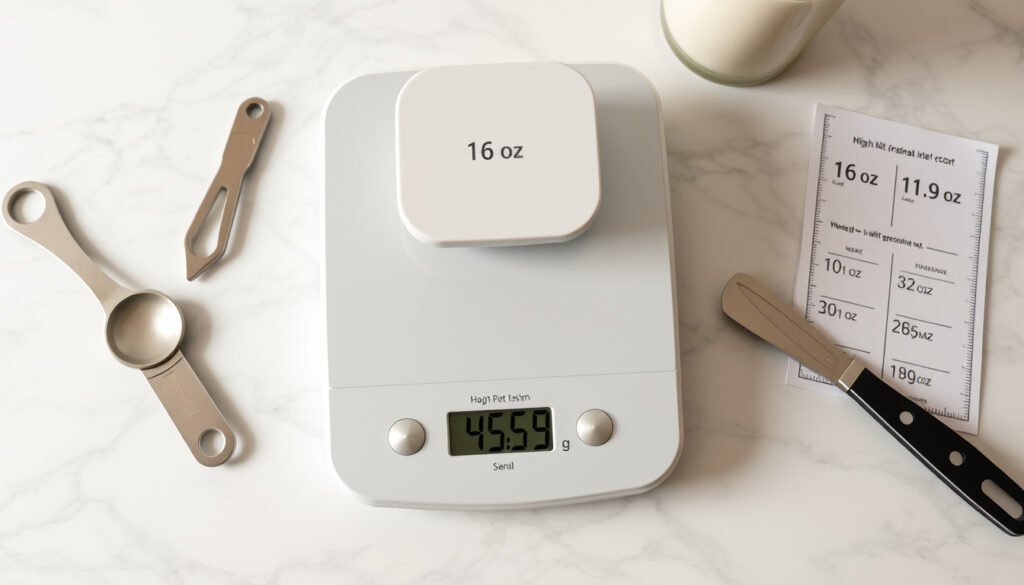
16 oz to Grams: Exact 453.59 g Conversion Guide
Your recipe calls for 16 ounces of flour, but your scale only shows grams. Here’s the catch: 16 oz is not 500 g, no matter how many websites suggest otherwise. The exact figure is 453.59 g, and that difference of 46 grams can throw off a batch of cookies or a loaf of bread. Below is the complete conversion breakdown, ingredient-specific examples, and a step-by-step guide to get it right every time.
16 oz in grams: 453.592 · 1 oz in grams: 28.34952 · 16 oz in kg: 0.453592 · Common baking equiv.: 16 oz ≈ 1 lb
Quick snapshot
- 16 oz = 453.59 g (Ounces to Grams Converter)
- 1 oz = 28.34952 g (standard US conversion) (Ounces to Grams Converter)
- Volume oz vs weight oz confusion in recipes
- Source-specific flour weights differ by 25%
- USDA flour standard: 125 g/cup
- King Arthur standard: 120 g/cup
- Step-by-step calculator approach
- Ingredient density guide
Key facts at a glance
A comparison table shows how 16 weight ounces translate across metric units.
| Label | Value |
|---|---|
| Exact 16 oz | 453.592 grams |
| Per ounce | 28.34952 grams |
| In kilograms | 0.453592 kg |
| Pounds equiv. | 1 lb |
Is 16 oz 500g?
No. The exact conversion is 453.59237 grams (Ounces to Grams Converter), which rounds to 453.59 g. The confusion comes from the metric system’s nice round numbers—500 g looks cleaner on packaging, which is why many recipe sites incorrectly list 16 oz as 500 g.
Exact conversion formula
To convert any ounce value to grams, multiply by 28.34952. For 16 oz: 16 × 28.34952 = 453.59237 g. This applies to weight ounces in the US customary system.
Why not exactly 500g
The ounce is a legacy unit that predates metric standardization. One international avoirdupois ounce equals exactly 28.349523125 grams. Since 16 does not divide evenly into metric-friendly numbers, you’ll always get a decimal result.
For home bakers, rounding to 454 g works fine. For professional pastry work where precision matters, stick with 453.59 g or weigh to 0.1 g.
What this means: rounding error compounds in baking, where flour hydration ratios control gluten development and texture.
Upsides
- Exact conversion is simple one-step math
- Works for all ingredients at the same rate
- No need to memorize ingredient-specific values
Downsides
- Recipes often use volume oz, not weight oz
- 16 fl oz water ≠ 16 weight oz
Does 16 oz equal 2 cups?
For fluids measured by volume, yes: 16 fluid ounces equals 2 US cups. But for weight, it depends entirely on the ingredient’s density. Two cups of flour weighs differently than two cups of cream cheese.
Cups depend on ingredient density
A cup is a volume measure (237 ml). When a recipe says “2 cups flour,” you’re scooping volume, not weighing mass. That means the gram equivalent varies by ingredient.
Water: 16 oz = 2 cups
Water is the exception: 1 US fluid ounce of water weighs approximately 1 ounce by weight. So 16 fl oz water ≈ 16 weight oz ≈ 454 g. This convenient coincidence does not apply to other ingredients.
Flour example
According to King Arthur Baking weight guide (a professional baking authority), 1 cup of all-purpose flour weighs 120 grams or 4.25 ounces. Two cups would be about 240 g or 8.5 oz—not 453 g.
Converting flour by weight: 16 oz flour ÷ 4.25 oz/cup = 3.76 cups. This is nearly 4 cups, not 2 cups. Relying on the “16 oz = 2 cups” rule for flour overfills your measuring cup by almost 90%.
The implication: volume-to-weight conversion varies dramatically by ingredient—never assume 16 oz equals 2 cups for dry goods.
Is 16 oz 500ml?
No. Weight ounces and fluid ounces measure different properties. Ounces as a unit of weight (oz) cannot equal milliliters, which measure volume. 16 weight ounces of water is about 473 ml, not 500 ml.
Weight vs fluid oz
Fluid ounces (fl oz) measure volume; weight ounces (oz) measure mass. The US fluid ounce equals approximately 29.5735 ml. So 16 fl oz = 16 × 29.5735 = 473.18 ml. This is roughly 27 ml short of 500 ml.
16 fl oz ≈ 473 ml
Converting 16 fluid ounces to milliliters: 16 × 29.5735 = 473.18 ml. For water, this weight is about 473 g, which is about 20 g more than the 453.59 g from 16 weight ounces.
The pattern: confusing weight and volume units creates a 20-gram discrepancy that scales with recipe size.
16 oz to grams for cream cheese
16 US fluid ounces of cream cheese equals approximately 450 grams according to multiple conversion sources (HowMany.wiki conversion calculator, CoolConversion volume-to-weight tool). This is slightly less than the 453.59 g pure weight conversion because cream cheese is less dense than water.
Standard density
Cream cheese density is approximately 0.99 g/ml, close to water but varying by brand and temperature. King Arthur Baking weight guide lists 1 cup cream cheese as 8 oz or 227 g.
Baking equivalents
Common cream cheese conversions for baking: a standard block is 8 oz (227 g), and two blocks (16 oz) equal approximately 450 g. Some recipes measure by tablespoons: 1 tablespoon of cream cheese is roughly 14 g.
When a recipe calls for 16 oz cream cheese, expect 450 g—not 500 g and not 453.59 g. The slight difference reflects how volume measurements interact with the ingredient’s density.
The catch: cream cheese brand variations can shift the effective weight by ±5%, so weighing is always more reliable than volume .
16 oz to grams flour
16 weight ounces of any flour equals 453.59 g. But when recipes use “ounces” for flour, they often mean volume ounces, not weight ounces. This creates a gap between what the recipe intends and what you actually weigh.
All-purpose flour
King Arthur Baking weight guide recommends 120 g per cup of all-purpose flour (4.25 oz). This means 16 oz weight = about 3.76 cups. Anna Olson baking reference lists 150 g/cup, while Weekend Bakery conversion data cites USDA at 125 g/cup—a 25% spread that can drastically change baking results.
Conversion tips
- Use a digital scale for accuracy
- Check which flour standard your recipe assumes
- 1 tablespoon flour = 8-9 g (Weekend Bakery measurement guide)
- Weight oz directly: 453 g; avoid volume confusion
What this means: professional bakers who consistently achieve predictable results follow the same flour standard their recipes were written for—switching standards mid-recipe guarantees different outcomes.
How to convert 16 oz to grams
Three approaches exist for converting 16 ounces to grams, depending on your tools and required precision.
For baking, a kitchen scale accurate to ±1 g works. For laboratory precision, use a scale with 0.01 g accuracy.
- Find the ounce value. Identify whether the recipe uses weight ounces (oz) or fluid ounces (fl oz). Most dry ingredient measurements use weight ounces.
- Apply the conversion factor. Multiply the ounce value by 28.34952. For 16 oz: 16 × 28.34952 = 453.59237 g.
- Round appropriately. Round to the nearest gram (454 g) for home cooking or nearest tenth (453.6 g) for precision baking. The difference is less than 0.1%.
- Verify with a scale. Place your ingredient on a calibrated scale set to grams. Compare the reading to your calculated value. A deviation greater than 5% suggests the recipe may have used volume ounces instead of weight.
If a recipe was written before digital scales were common, “ounces” likely means volume. The conversion factor 28.35 g/oz only applies to weight ounces—applying it to volume measurements overestimates by 10-30%.
The implication: older recipes using “ounces” without clarification require you to infer whether the author meant weight or volume, which only works if you know the ingredient’s density.
Conversion reference chart
Seven common baking ingredients show how weight per cup varies by density.
| Ingredient | Per cup (grams) | Per oz (grams) |
|---|---|---|
| All-purpose flour (King Arthur) | 120 | 28.35 |
| Bread flour | 157 | 28.35 |
| Whole wheat flour | 144 | 28.35 |
| Butter | 227 | 28.35 |
| Granulated sugar | 200 | 28.35 |
| Cream cheese | 227 | 28.35 |
| Heavy cream | 240 | 28.35 |
The pattern is clear: protein-rich flours (bread, whole wheat) weigh more per cup than refined flours. Fats (butter, cream cheese) cluster around 227 g/cup, while liquids (cream) approach water’s density at 240 g/cup.
Related reading: How Many mL in a Tablespoon · 1 Inch to MM
This 453.59 g standard aligns with avoirdupois measures, where the 16oz to grams distinctions clarify Troy and fluid ounce variants for baking precision.
Frequently asked questions
Is 8 oz 250 g?
No. 8 oz equals 226.796 g (8 × 28.34952). This is about 23 g less than 250 g. The 250 g figure sometimes appears for 1 cup cream cheese by certain sources, but it represents a volume-based estimate, not a weight conversion.
Is 250 grams 16 oz?
No. 250 g equals approximately 8.82 oz (250 ÷ 28.34952). That’s less than half of 16 oz. The confusion arises when people confuse volume measurements (2 cups) with weight.
Is 16 oz 1 kg?
No. 16 oz equals 0.453592 kg—less than half a kilogram. 1 kg is approximately 35.27 oz, or about 2.2 pounds.
Is 16 oz 250 g?
No. 16 oz is 453.59 g, which is roughly 80% more than 250 g. The common mistake of equating these two values likely stems from rounding confusion between volume and weight measurements.
Is 350 g 8 oz?
Yes, approximately. 350 g ÷ 28.34952 = 12.35 oz. Conversely, 8 oz = 226.8 g, which is about 65% of 350 g. The two values are not interchangeable.
How many 16 oz are in 1 cup?
Zero, if measuring by volume. 1 US cup equals 8 fluid ounces by volume. 16 weight ounces is twice that amount. However, 16 fluid ounces equals 2 cups by volume—the confusion between fluid and weight ounces is where most conversion errors occur.
How many ounces is a cup dry?
It depends entirely on the ingredient. “A cup” is a volume measure of 237 ml. Dry ingredients vary by density: 1 cup flour is 4.25 oz, while 1 cup butter is 8 oz. There is no universal dry ounce conversion.
King Arthur Baking (Professional baking authority)
For best results, we recommend weighing your ingredients with a digital scale.
Anna Olson (Professional baker and culinary expert)
A cup of all-purpose flour weighs 120 grams or 4 1/4 ounces.
More related posts
 ASUS ROG Ally X Review: Worth It? Specs vs Steam Deck OLED
 Aretha Franklin: Her Life, Death and Estate Battle
 Christiane Amanpour: Biography, Illness, and Net Worth
 Seth Jarvis: Injury, Contract, Salary & Personal Life
 Pension Payment Dates 2026: Rates & Schedules
 Zach Hyman: Injury, Salary, Family, and Career Facts
 Blac Chyna 2024: Lawsuit, OnlyFans Exit & Net Worth
 Tony Curtis’s Will: Disinherited Jamie Lee and Family Feud