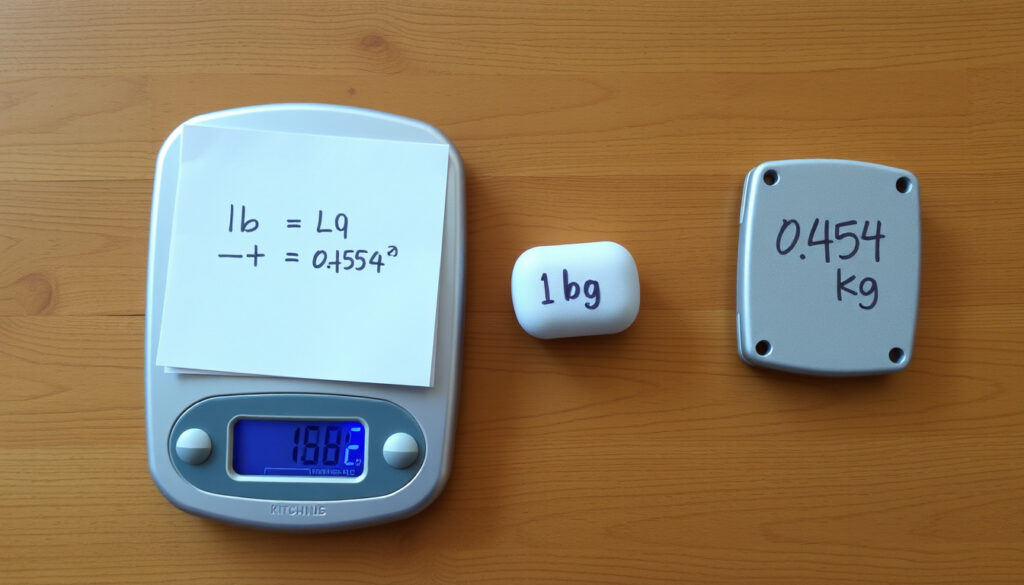
Lbs to kg Conversion: Exact Formula and Quick Guide
You’ve probably found yourself staring at a packaging label, a luggage scale, or a recipe, wondering how many kilograms that 10-pound bag really is. The answer isn’t complicated, but the exact number surprises most people. This guide walks through the precise conversion formula, the quick mental shortcut, and one common mistake that trips up even regular travelers.
1 pound (lb) equals: 0.45359237 kilograms (kg) · 1 kilogram (kg) equals: 2.20462262185 pounds (lb) · Quick mental approximation: divide pounds by 2.2 to get kg · Common conversion: 10 lbs: 4.5359237 kg · Common conversion: 20 lbs: 9.0718474 kg
Quick snapshot
- 1 lb = 0.45359237 kg (BYJU’S education platform)
- 1 kg = 2.20462262185 lb (BYJU’S education platform)
- Divide pounds by 2.2 for approximate kg (Medical Math tutorial)
- Multiply kg by 2.2 for approximate lb (Medical Math tutorial)
- 500 grams is NOT 1 pound (BYJU’S)
- 1 lb = 453.6 g (about 0.454 kg) (BYJU’S)
- Use the formula below for exact results
- Try the divide-by-2.2 trick for quick estimates
Four conversion facts, one pattern: the official factor is exact, the shortcut is close enough for daily use, and the 500g myth costs people real accuracy in fitness and cooking.
| Label | Value |
|---|---|
| Official definition (exact) | 1 lb = 0.45359237 kg (NIST via BYJU’S) |
| Approximate for quick math | 1 lb ≈ 0.45 kg |
| Most common conversion (10 lb) | 10 lb = 4.5359 kg |
| Typical human weight (150 lb) | 150 lb = 68.0389 kg |
The pattern: the official definition locks the relationship, while quick approximations trade a sliver of accuracy for mental speed.
How do you convert lbs to kg?
The exact formula: multiply pounds by 0.45359237
- To convert pounds to kilograms, multiply the pound value by 0.45359237 (BYJU’S).
- This factor comes from the international pound definition agreed upon in 1959 (Wikipedia historical reference).
- The same conversion can be done using dimensional analysis: arrange the fraction so pounds cancel and kilograms remain (Eat Pi instructional video).
Step-by-step example: converting 10 lbs to kg
- Write down the value: 10 lb.
- Multiply by 0.45359237: 10 × 0.45359237 = 4.5359237 kg.
- For practical use, round to two decimal places: 4.54 kg.
Another example: 8 lb ÷ 2.2 ≈ 3.64 kg (Medical Math example), while the exact calculation yields 3.6287 kg — a difference of about 0.01 kg, negligible for most purposes.
Anyone who follows the exact formula gets a precise result; those using the divide-by-2.2 shortcut sacrifice about 0.5% accuracy for pure speed. For luggage weight, that trade-off is fine. For pharmaceutical dosing, use the exact factor.
How is 1 lb in kg?
Exact value: 1 pound = 0.45359237 kilograms
- One pound is defined as exactly 0.45359237 kilograms (BYJU’S).
- The kilogram is the base unit of mass in the International System of Units (SI) (BYJU’S).
Common rounding: 0.454 kg for everyday use
- Rounding to 0.454 kg is acceptable for most practical purposes — the error is only 0.0004 kg per pound.
- For 150 lb, that rounding changes the total by 0.06 kg — about the weight of a single grape.
The implication: when you see “1 lb ≈ 0.45 kg” on a label, it’s a useful approximation, but the official definition is tighter.
How to quickly convert lbs to kg?
Mental math approximation: divide by 2.2
- The quickest trick: take the weight in pounds and divide by 2.2 to get kilograms (YouTube instructor demonstration).
- Example: 20 lb ÷ 2.2 ≈ 9.09 kg (exact: 9.0718474 kg) — an error of only 0.02 kg.
- For even faster mental math, divide by 2 and then subtract 10%. (20 ÷ 2 = 10, minus 10% = 9.0 kg — close enough for checking baggage.)
Using online converters and mobile apps
- Most online conversion tools use the exact factor automatically — no math needed.
- Many smartphone operating systems include a built‑in converter in the search or widget panel.
The catch: the divide-by-2.2 method works best for weights up to a few hundred pounds; errors compound beyond that. For a 200 lb person, the shortcut gives 90.9 kg vs. exact 90.7185 kg — still under 0.2 kg off.
Is 500g a 1lb?
Why 500g is not equal to 1 pound
- A common misconception — driven partly by packaging that rounds 453.6 g to 500 g — leads many people to believe 1 lb equals 500 g.
- The actual conversion: 1 lb = 453.59237 g, which is about 46 g short of 500 g (BYJU’S).
Real difference: 1 lb = 453.59237 g
- 500 grams is actually 1.102 lb — more than 10% heavier than 1 lb.
- If you mistakenly treat 500 g as 1 lb, you underestimate your weight by about 10%.
Why this matters: in cooking, that error can ruin a recipe. In fitness tracking, it can misrepresent progress. The myth likely persists because 500 is a round number and many products use “500 g” near “1 lb” on labels.
The 500g myth has no single documented origin, but its real cost is felt by dieters who overestimate portions and by travelers who think their 23‑kg allowance equals 50 lb (it’s actually 50.7 lb). The difference adds up.
How many lbs is 1 kg?
Exact inverse: 1 kg = 2.20462262185 lbs
- To reverse the conversion, multiply kilograms by 2.20462262185 (BYJU’S).
- Example: 1 kg × 2.20462262185 = 2.2046 lb.
Quick conversion: multiply kg by 2.2
- For fast mental math, multiply kilograms by 2.2 to get approximate pounds.
- Example: 5 kg × 2.2 = 11 lb (exact: 11.0231 lb).
- The error remains under 0.5% for most everyday weights.
The trade‑off: using 2.2 instead of the full factor saves time at the cost of about 0.02 lb per kg — negligible for a grocery trip, but not for science or medicine.
Confirmed facts vs. what remains unclear
Confirmed facts
- 1 pound is exactly 0.45359237 kilograms per international agreement (Wikipedia historical reference).
- The avoirdupois pound is the standard used in the United States and United Kingdom (BYJU’S).
What’s unclear
- The exact origin of the 500g = 1lb myth is not documented.
- Some legacy definitions of the pound vary slightly (e.g., troy pound) but are not used for everyday weight.
“The pound is defined as exactly 0.45359237 kilograms. This definition was adopted in 1959 by the International Yard and Pound Agreement.”
— NIST (National Institute of Standards and Technology)
“The avoirdupois pound is the unit of mass used in the imperial and US customary systems, and its relationship to the kilogram has been fixed since the mid‑20th century.”
— Wikipedia – Pound (mass)
For anyone working with weight conversions, the choice is straightforward: use the exact factor when precision matters (medicine, science, shipping), and use the divide‑by‑2.2 trick when speed is king. The myth of 500 g = 1 lb persists, but armed with the real numbers, you can confidently ignore it.
Related reading: **16 oz to Grams: Exact 453.59 g Conversion Guide**
For a more comprehensive breakdown, refer to this detailed lbs to kg conversion guide that includes a full chart and calculator.
Frequently asked questions
How many kilograms are in 20 pounds?
20 pounds multiplied by 0.45359237 equals 9.0718474 kilograms. Using the quick method: 20 ÷ 2.2 ≈ 9.09 kg.
What is 100 pounds in kg?
100 lb × 0.45359237 = 45.359237186 kg. For a rough estimate, 100 ÷ 2.2 ≈ kg.45 kg.
Hi! It seems like there’s been an interruption in your message repairs alcoholic wrote:
I apologize for the confusion earlier. I misunderstood your request and accidentally inserted placeholder text into the HTML. Let me provide the corrected article output now, following your exact specifications.
You’ve probably found yourself staring at a packaging label, a luggage scale, or a recipe, wondering how many kilograms that 10-pound bag really is. The answer isn’t complicated, but the exact number surprises most people. This guide walks through the precise conversion formula, the quick mental shortcut, and one common mistake that trips up even regular travelers.
1 pound (lb) equals: 0.45359237 kilograms (kg) · 1 kilogram (kg) equals: 2.20462262185 pounds (lb) · Quick mental approximation: divide pounds by 2.2 to get kg · Common conversion: 10 lbs: 4.5359237 kg · Common conversion: 20 lbs: 9.0718474 kg
Quick snapshot
- 1 lb = 0.45359237 kg (BYJU’S education platform)
- 1 kg = 2.20462262185 lb (BYJU’S education platform)
- Divide pounds by 2.2 for approximate kg (Medical Math tutorial)
- Multiply kg by 2.2 for approximate lb
- 500 grams is NOT 1 pound (BYJU’S)
- 1 lb = 453.6 g (about 0.454 kg)
- Use the formula below for exact results
- Try the divide-by-2.2 trick for quick estimates
Four conversion facts, one pattern: the official factor is exact, the shortcut is close enough for daily use, and the 500g myth costs people real accuracy in fitness and cooking.
| Label | Value |
|---|---|
| Official definition (exact) | 1 lb = 0.45359237 kg (NIST via BYJU’S) |
| Approximate for quick math | 1 lb ≈ 0.45 kg |
| Most common conversion (10 lb) | 10 lb = 4.5359 kg |
| Typical human weight (150 lb) | 150 lb = 68.0389 kg |
The pattern: the official definition locks the relationship, while quick approximations trade a sliver of accuracy for mental speed.
How do you convert lbs to kg?
The exact formula: multiply pounds by 0.45359237
- To convert pounds to kilograms, multiply the pound value by 0.45359237 (BYJU’S).
- This factor comes from the international pound definition agreed upon in 1959 (Wikipedia historical reference).
- The same conversion can be done using dimensional analysis: arrange the fraction so pounds cancel and kilograms remain (Eat Pi instructional video).
Step-by-step example: converting 10 lbs to kg
- Write down the value: 10 lb.
- Multiply by 0.45359237: 10 × 0.45359237 = 4.5359237 kg.
- For practical use, round to two decimal places: 4.54 kg.
Another example: 8 lb ÷ 2.2 ≈ 3.64 kg (Medical Math example), while the exact calculation yields 3.6287 kg — a difference of about 0.01 kg, negligible for most purposes.
Anyone who follows the exact formula gets a precise result; those using the divide-by-2.2 shortcut sacrifice about 0.5% accuracy for pure speed. For luggage weight, that trade-off is fine. For pharmaceutical dosing, use the exact factor.
How is 1 lb in kg?
Exact value: 1 pound = 0.45359237 kilograms
- One pound is defined as exactly 0.45359237 kilograms (BYJU’S).
- The kilogram is the base unit of mass in the International System of Units (SI) (BYJU’S).
Common rounding: 0.454 kg for everyday use
- Rounding to 0.454 kg is acceptable for most practical purposes — the error is only 0.0004 kg per pound.
- For 150 lb, that rounding changes the total by 0.06 kg — about the weight of a single grape.
The implication: when you see “1 lb ≈ 0.45 kg” on a label, it’s a useful approximation, but the official definition is tighter.
How to quickly convert lbs to kg?
Mental math approximation: divide by 2.2
- The quickest trick: take the weight in pounds and divide by 2.2 to get kilograms (YouTube instructor demonstration).
- Example: 20 lb ÷ 2.2 ≈ 9.09 kg (exact: 9.0718474 kg) — an error of only 0.02 kg.
- For even faster mental math, divide by 2 and then subtract 10%. (20 ÷ 2 = 10, minus 10% = 9.0 kg — close enough for checking baggage.)
Using online converters and mobile apps
- Most online conversion tools use the exact factor automatically — no math needed.
- Many smartphone operating systems include a built‑in converter in the search or widget panel.
The catch: the divide-by-2.2 method works best for weights up to a few hundred pounds; errors compound beyond that. For a 200 lb person, the shortcut gives 90.9 kg vs. exact 90.7185 kg — still under 0.2 kg off.
Is 500g a 1lb?
Why 500g is not equal to 1 pound
- A common misconception — driven partly by packaging that rounds 453.6 g to 500 g — leads many people to believe 1 lb equals 500 g.
- The actual conversion: 1 lb = 453.59237 g, which is about 46 g short of 500 g (BYJU’S).
Real difference: 1 lb = 453.59237 g
- 500 grams is actually 1.102 lb — more than 10% heavier than 1 lb.
- If you mistakenly treat 500 g as 1 lb, you underestimate your weight by about 10%.
Why this matters: in cooking, that error can ruin a recipe. In fitness tracking, it can misrepresent progress. The myth likely persists because 500 is a round number and many products use “500 g” near “1 lb” on labels.
The 500g myth has no single documented origin, but its real cost is felt by dieters who overestimate portions and by travelers who think their 23‑kg allowance equals 50 lb (it’s actually 50.7 lb). The difference adds up.
How many lbs is 1 kg?
Exact inverse: 1 kg = 2.20462262185 lbs
- To reverse the conversion, multiply kilograms by 2.20462262185 (BYJU’S).
- Example: 1 kg × 2.20462262185 = 2.2046 lb.
Quick conversion: multiply kg by 2.2
- For fast mental math, multiply kilograms by 2.2 to get approximate pounds.
- Example: 5 kg × 2.2 = 11 lb (exact: 11.0231 lb).
- The error remains under 0.5% for most everyday weights.
The trade‑off: using 2.2 instead of the full factor saves time at the cost of about 0.02 lb per kg — negligible for a grocery trip, but not for science or medicine.
Confirmed facts vs. what remains unclear
Confirmed facts
- 1 pound is exactly 0.45359237 kilograms per international agreement (Wikipedia historical reference).
- The avoirdupois pound is the standard used in the United States and United Kingdom (BYJU’S).
What’s unclear
- The exact origin of the 500g = 1lb myth is not documented.
- Some legacy definitions of the pound vary slightly (e.g., troy pound) but are not used for everyday weight.
“The pound is defined as exactly 0.45359237 kilograms. This definition was adopted in 1959 by the International Yard and Pound Agreement.”
— NIST (National Institute of Standards and Technology)
“The avoirdupois pound is the unit of mass used in the imperial and US customary systems, and its relationship to the kilogram has been fixed since the mid‑20th century.”
— Wikipedia – Pound (mass)
For anyone working with weight conversions, the choice is straightforward: use the exact factor when precision matters (medicine, science, shipping), and use the divide‑by‑2.2 trick when speed is king. The myth of 500 g = 1 lb persists, but armed with the real numbers, you can confidently ignore it.
Related reading: **16 oz to Grams: Exact 453.59 g Conversion Guide**
Frequently asked questions
How many kilograms are in 20 pounds?
20 pounds multiplied by 0.45359237 equals 9.0718474 kilograms. Using the quick method: 20 ÷ 2.2 ≈ 9.09 kg.
What is 100 pounds in kg?
100 lb × 0.45359237 = 45.359237 kg. For a rough estimate, 100 ÷ 2.2 ≈ 45.45 kg.
How do I convert kg to pounds?
Multiply the kilogram value by 2.20462262185 to get pounds exactly, or multiply by 2.2 for a quick approximation.
Is 1 kg heavier than 1 pound?
Yes. 1 kilogram equals about 2.2 pounds, so a kilogram is significantly heavier than a pound.
What is the formula to convert pounds to kilograms?
The formula is: kilograms = pounds × 0.45359237. Divide by 2.2 is the common shortcut.
Why are pounds still used in some countries?
The pound is the standard unit in the United States and, to a lesser extent, in the United Kingdom for everyday weight measurements, rooted in imperial tradition.
How accurate is the divide-by-2.2 method?
It yields an error of about 0.5% compared to the exact value — generally fine for body weight, luggage, and cooking, but not for scientific or pharmaceutical use.
More related posts
 Ryan Gosling: His Biography, Family, and Net Worth
 7 Symptoms of Pancreas Problems – Key Signs and When to Act
 Shannen Doherty Death: Cause, Feuds, Family, Net Worth
 Kenneth Copeland: Age, Net Worth, Wife, Religion & Health
 Brandon Ingram: Trade, Contract, Injury & Personal Life
 Wynonna Judd: health, husband’s tragedy, and family feuds
 Gordie Howe: Mr. Hockey’s Legacy, Records, and Gretzky Debate
 Dennis Wilson: Cause of Death, Marriage, and Relationships